10 hr
Jaipur Full-Day Tour: Amer Fort, City Palace & Nahargarh Sunset
- Expert local guide
- Small group
- Skip-the-line access
- Free cancellation
Nahargarh Fort Tickets — Aravalli Hilltop Entry & Sunset Access
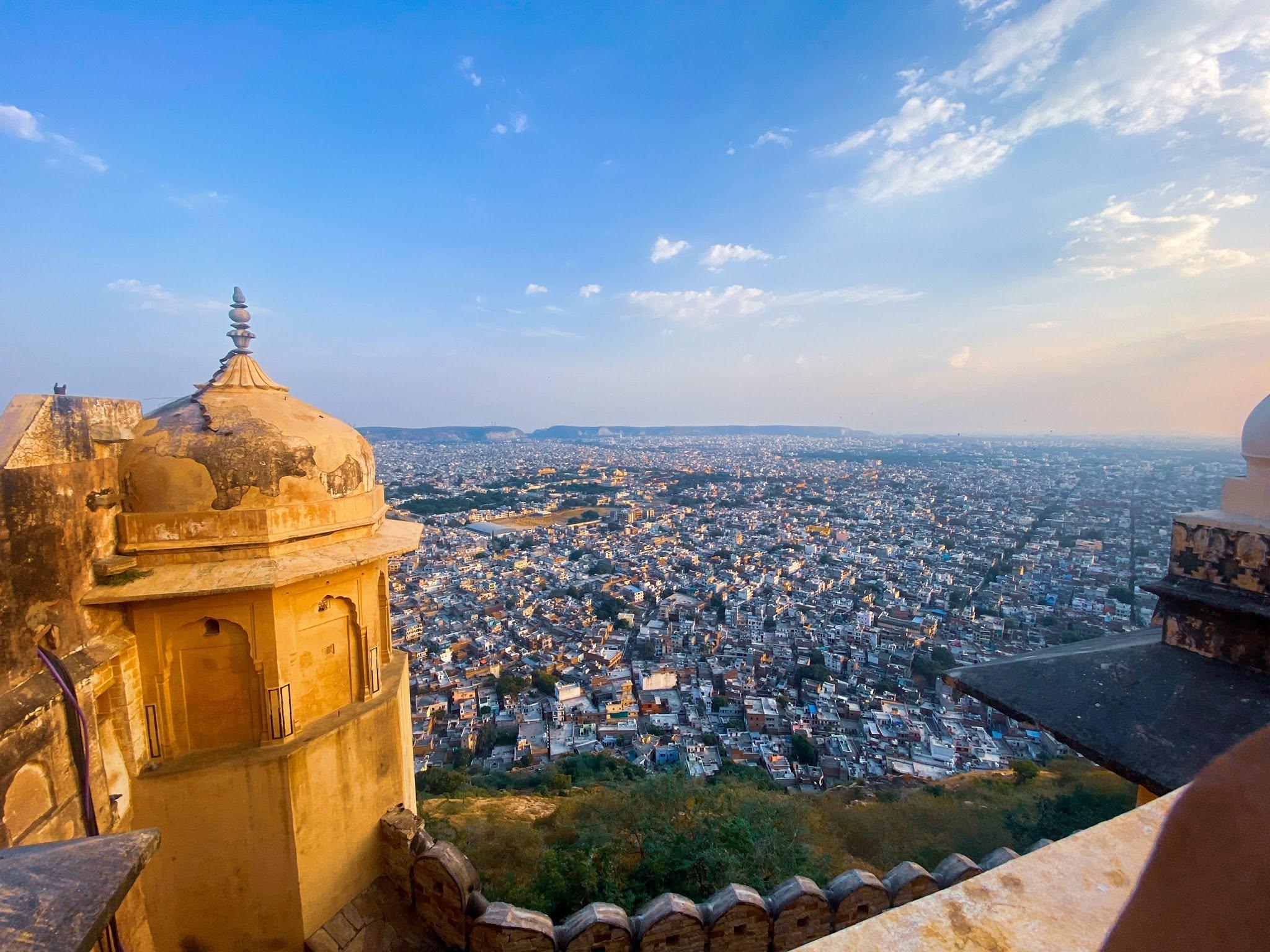
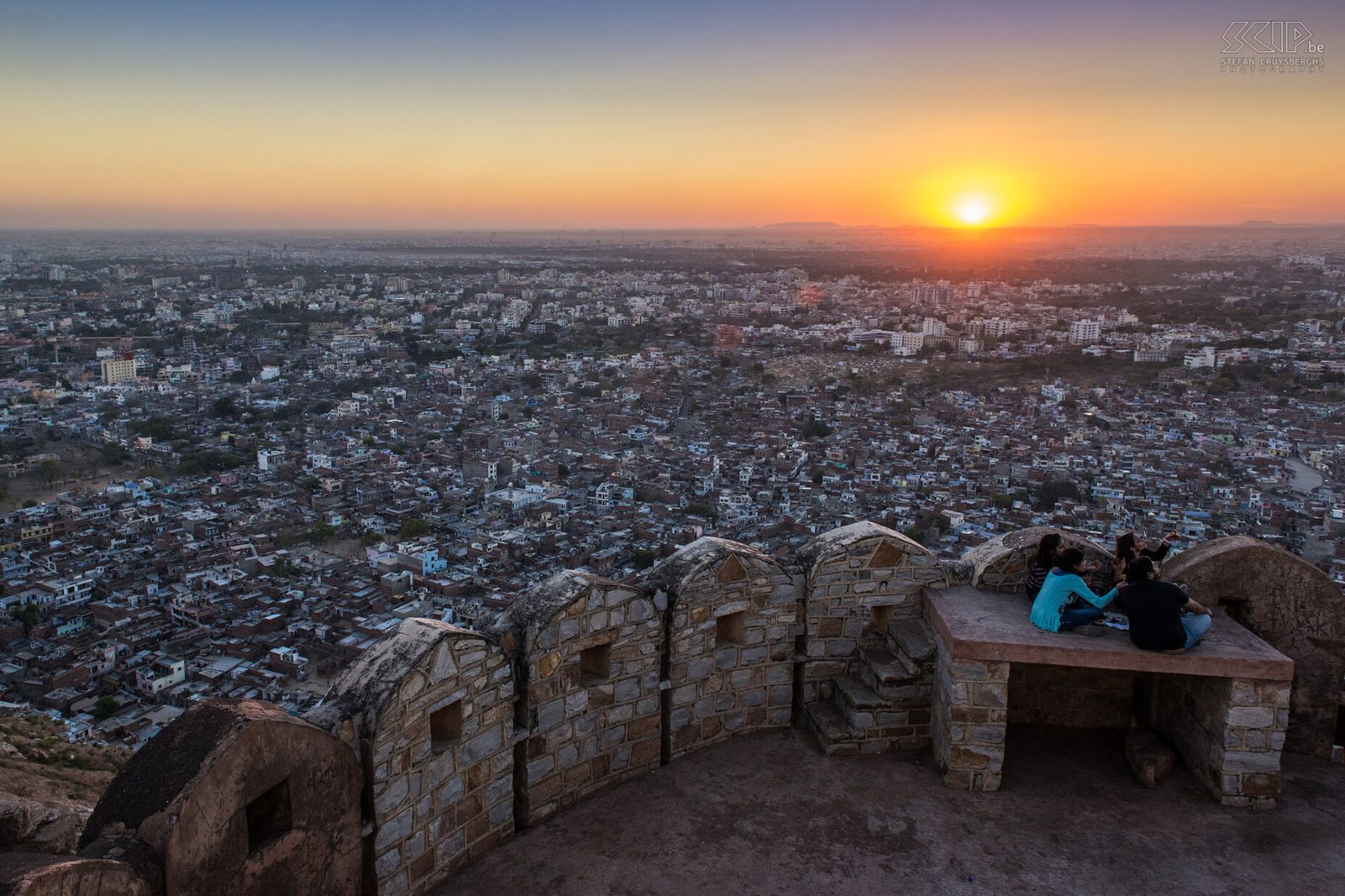
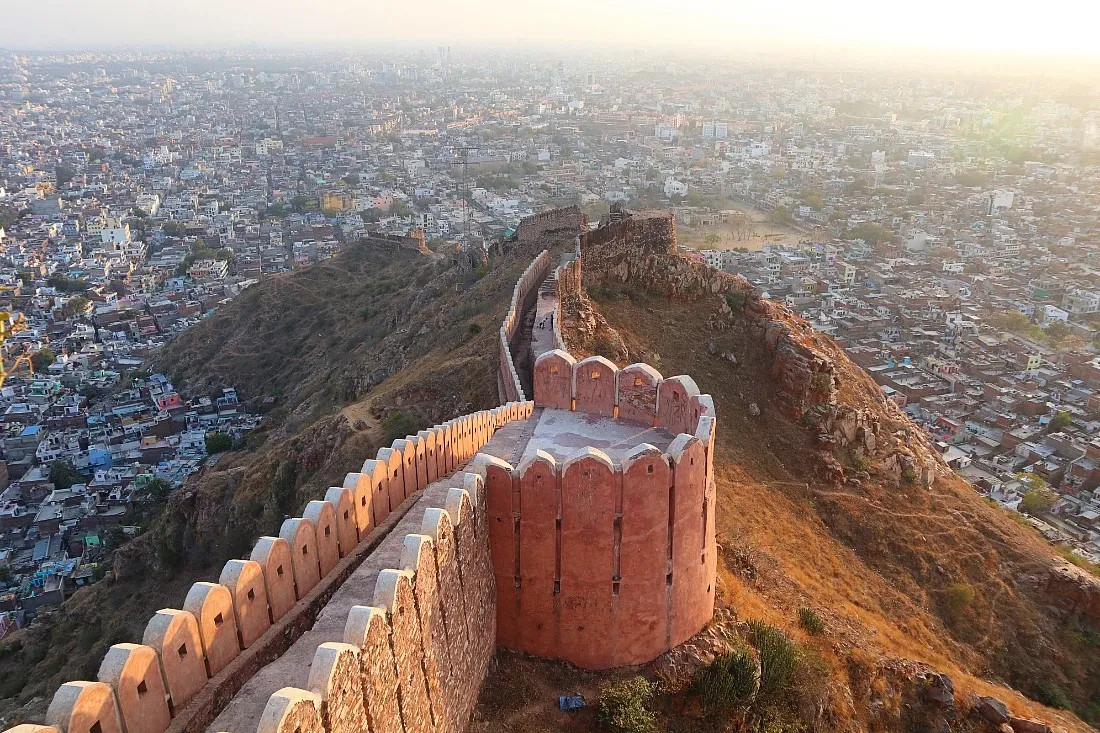
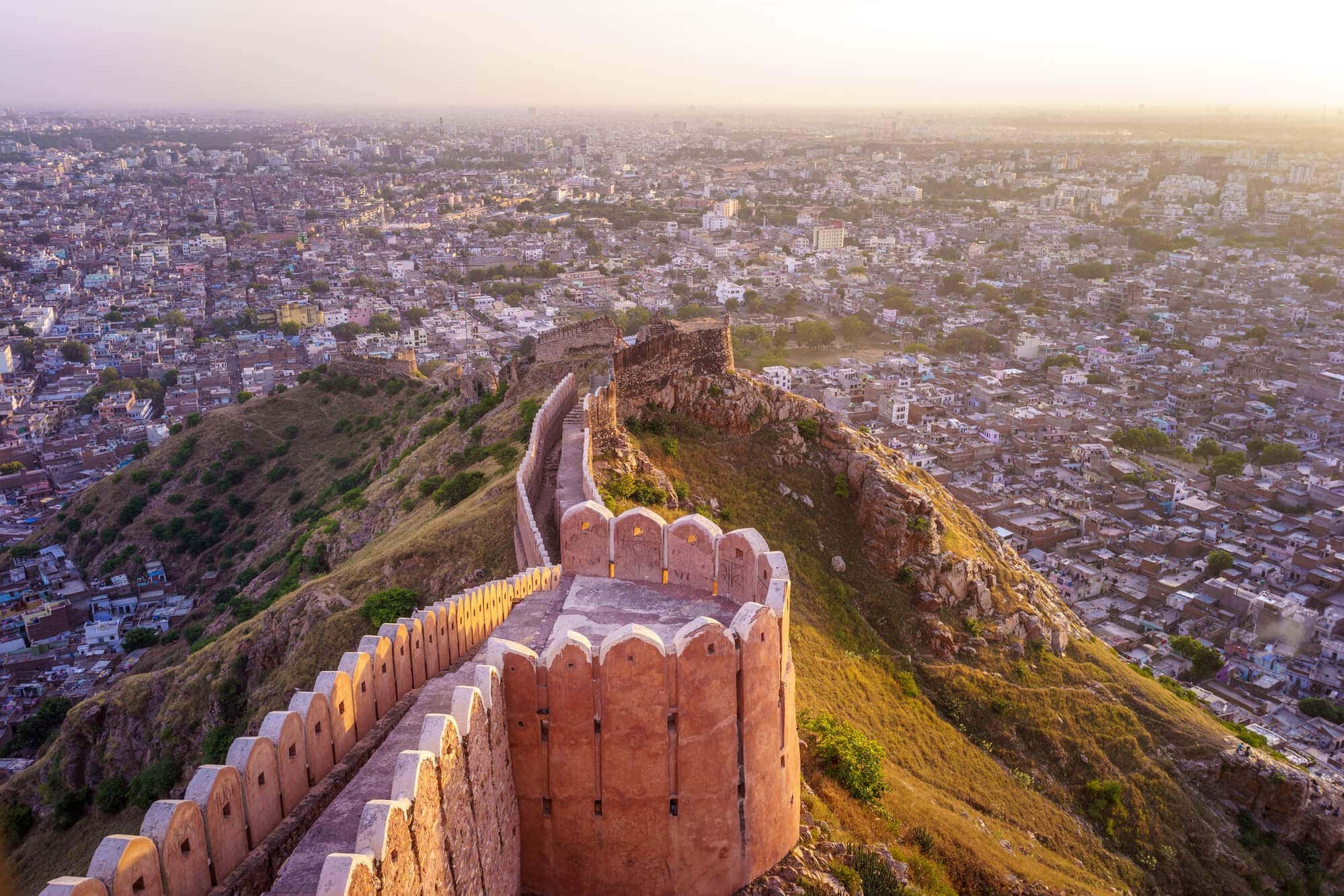
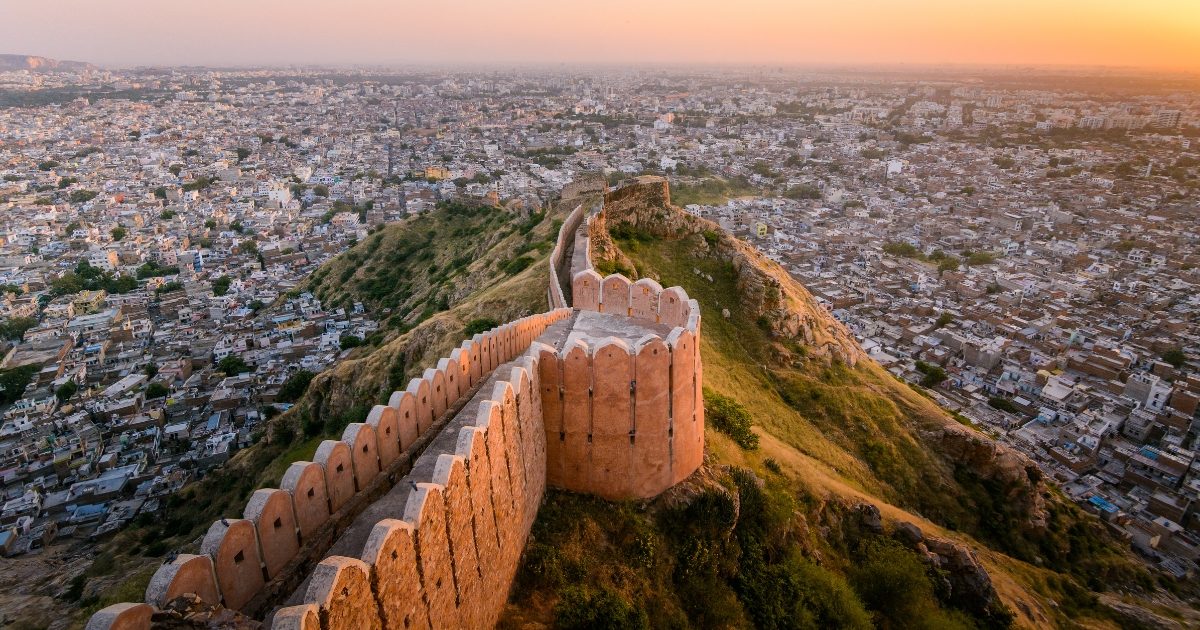
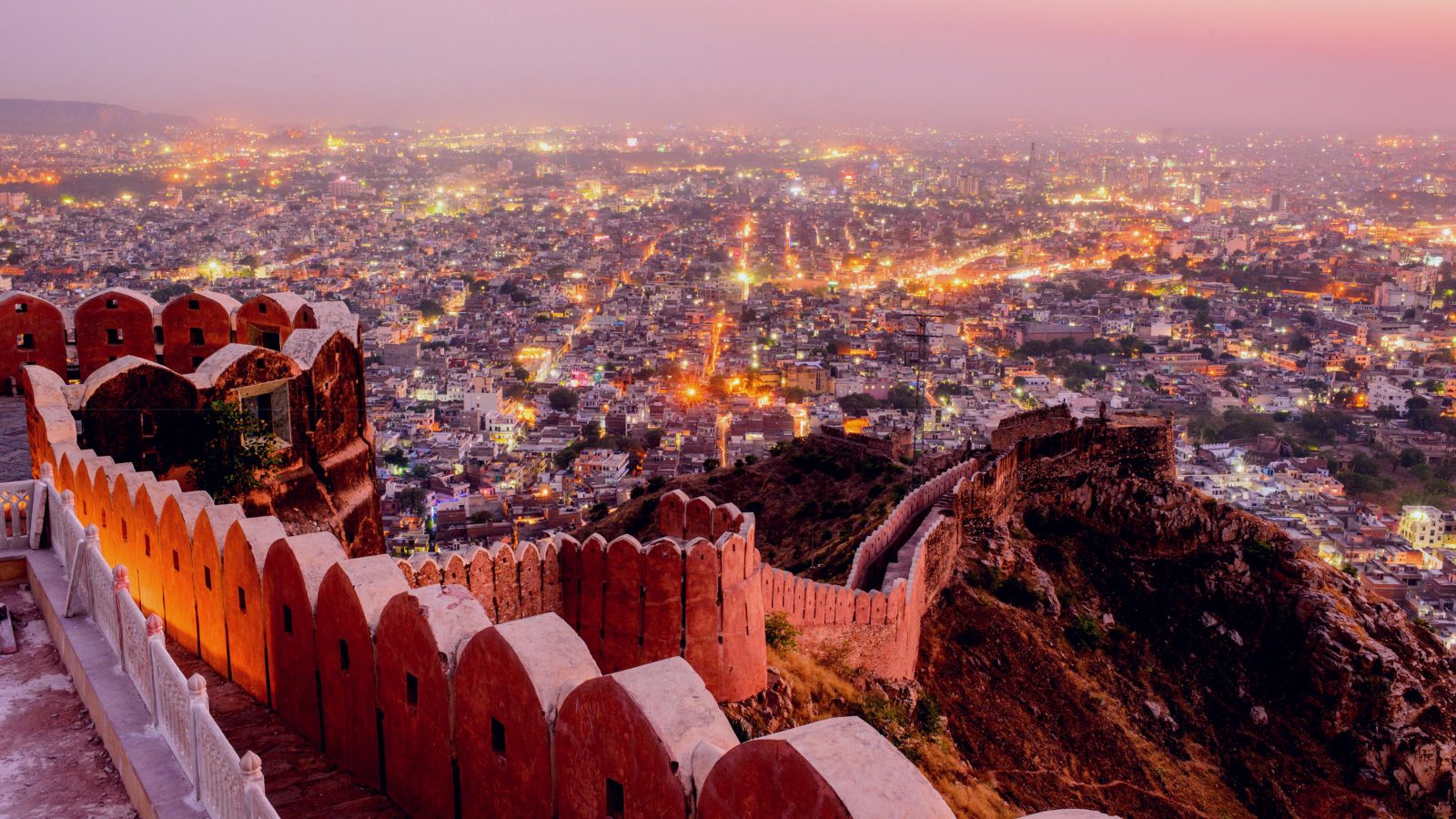
Ramparts above the Pink City, light folding into dusk
Compare fares, pick the fit — all bookings are mobile-voucher and eligible for free cancellation where shown.
10 hr
8 hr
8 hr
| Experience | Duration | Rating | Transfers | Pickup | Guide | Free cancel. | Price | |
|---|---|---|---|---|---|---|---|---|
|
Guided Experience
Most popular
Jaipur Full-Day Tour: Amer Fort, City Palace & Nahargarh Sunset
|
10 hr | ★ 5.0 | — | ✓ | ✓ | ✓ | €9 | Book → |
|
Luxury / Private
Jaipur & Amber Fort Private Guided Tour – Half or Full Day
|
8 hr | ★ 4.8 | ✓ | ✓ | ✓ | ✓ | €7 | Book → |
|
Luxury / Private
Jaipur Full-Day Private City Tour with Car & Guide
|
8 hr | ★ 4.8 | ✓ | ✓ | ✓ | ✓ | €9 | Book → |
Worth it for sunset and views, not interiors
At 600 INR for foreign adults, nahargarh fort tickets buy you the ramparts, Madhavendra Bhawan's frescoed royal apartments, and the wide sweep of Jaipur city laid out below the Aravalli ridge. That is the real value: the panorama and the golden-hour light, not the exhibits. The on-site wax museum is a separate paid add-on, so budget for it or skip it. Weighed purely on interiors, some visitors find the hilltop palace thin — faded murals, sparse signage, a quick loop. But arrive in the 15:30–17:00 window and the ridgeline views over the Pink City justify the fee on their own. These Jaipur landmarks reward people who come for atmosphere and photographs rather than dense museum content. A skip-the-line ticket saves time in peak season. For most first-timers building nahargarh fort tickets tours around a sunset stop, the spend pays off; for interior-hunters, it underwhelms.
Bottom line: Book the nahargarh fort tickets tour for sunset and you will not regret the 600 INR; come only for the interiors and you might.
Nahargarh's sunset ramparts and Jaigarh's cannon-and-armory grounds sit six kilometers apart on the same ridge, and most travelers booking nahargarh fort tickets end up asking which hilltop to prioritize when time is short. If you're choosing one, go with Nahargarh for the golden-hour skyline over Jaipur; add Jaigarh only if military architecture and the Jaivana cannon matter more to you than the view.
|
Top pick Nahargarh Fort |
Jaigarh Fort | |
|---|---|---|
| What you see | Madhavendra Palace, ramparts, city skyline | Jaivana cannon, armory museum, watchtowers |
| Crowd levels | Moderate, busiest at sunset | Lighter, mostly Indian tour groups |
| Best time of day | 15:30–17:00 for sunset light | Morning, cooler and quieter |
| Price | 600 INR (foreign adult) | 200 INR (foreign adult) |
| Time needed | 1.5–2 hours | 1.5–3 hours |
| Combine with Amer Fort | 20–30 min drive via ridge road | Connected by underground passage |
| See tickets & prices |
Verdict: Nahargarh wins on scenery and ease of access for a sunset-focused Jaipur landmarks itinerary, while Jaigarh rewards visitors who want fort tour depth on Rajput military history and can walk the underground link straight from Amer Fort.
Hand-picked experiences loved by thousands of travelers
1.5 - 2.5 hours
Free Cancellation
Explore Jaipur's UNESCO-listed Amber Fort with a private guide sharing centuries of royal history.
8 hours
Free Cancellation
Private guided day trip through Jaipur's forts, palaces, and UNESCO observatory, with AC car and hotel pickup.
4 hours
Free Cancellation
Explore Jaipur's iconic sights in comfort with a private guide, driver, and flexible pace.
4 hours
Free Cancellation
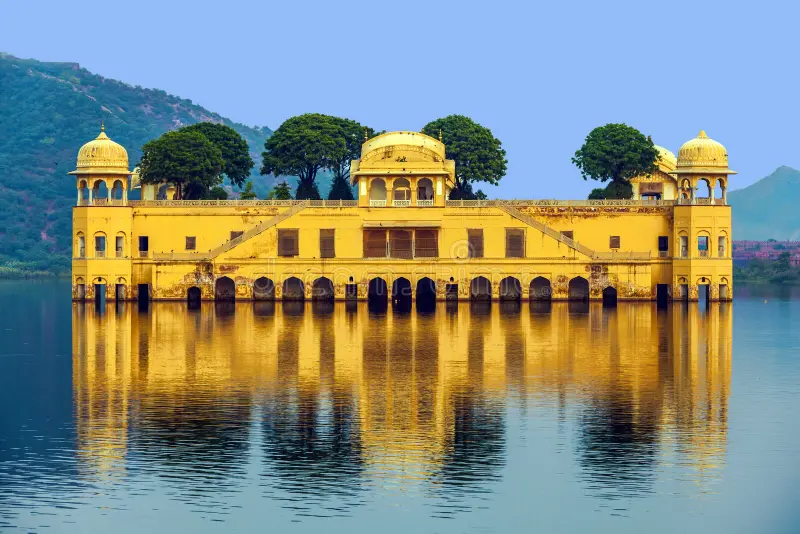
Private half-day Jaipur tour to Amer Fort, a hidden stepwell, and the floating Jal Mahal.
2 hours
Free Cancellation
Explore Amber Fort's mirrored palaces and hilltop ramparts with a knowledgeable local guide.
Ticket verification and bag screening at the main gate before entering the fort courtyard
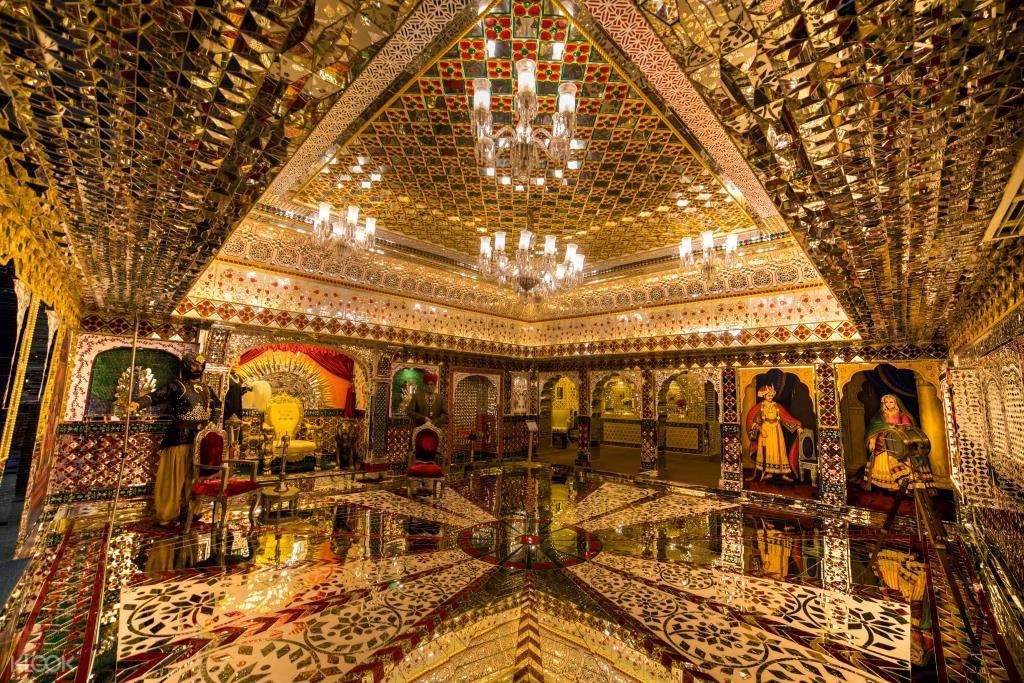
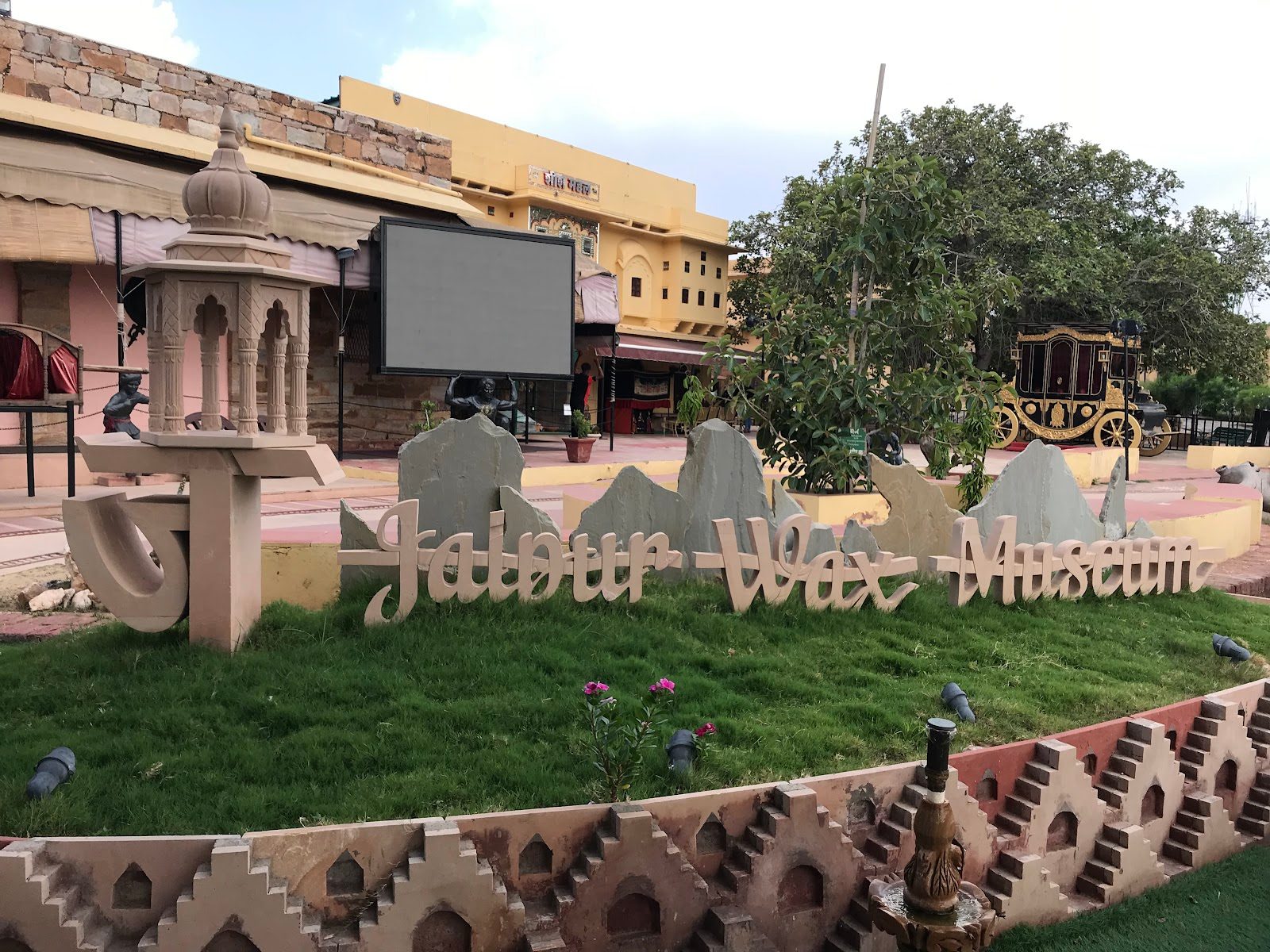
Walk through the wax statue galleries and the mirror-work Palace of Mirrors near the entrance
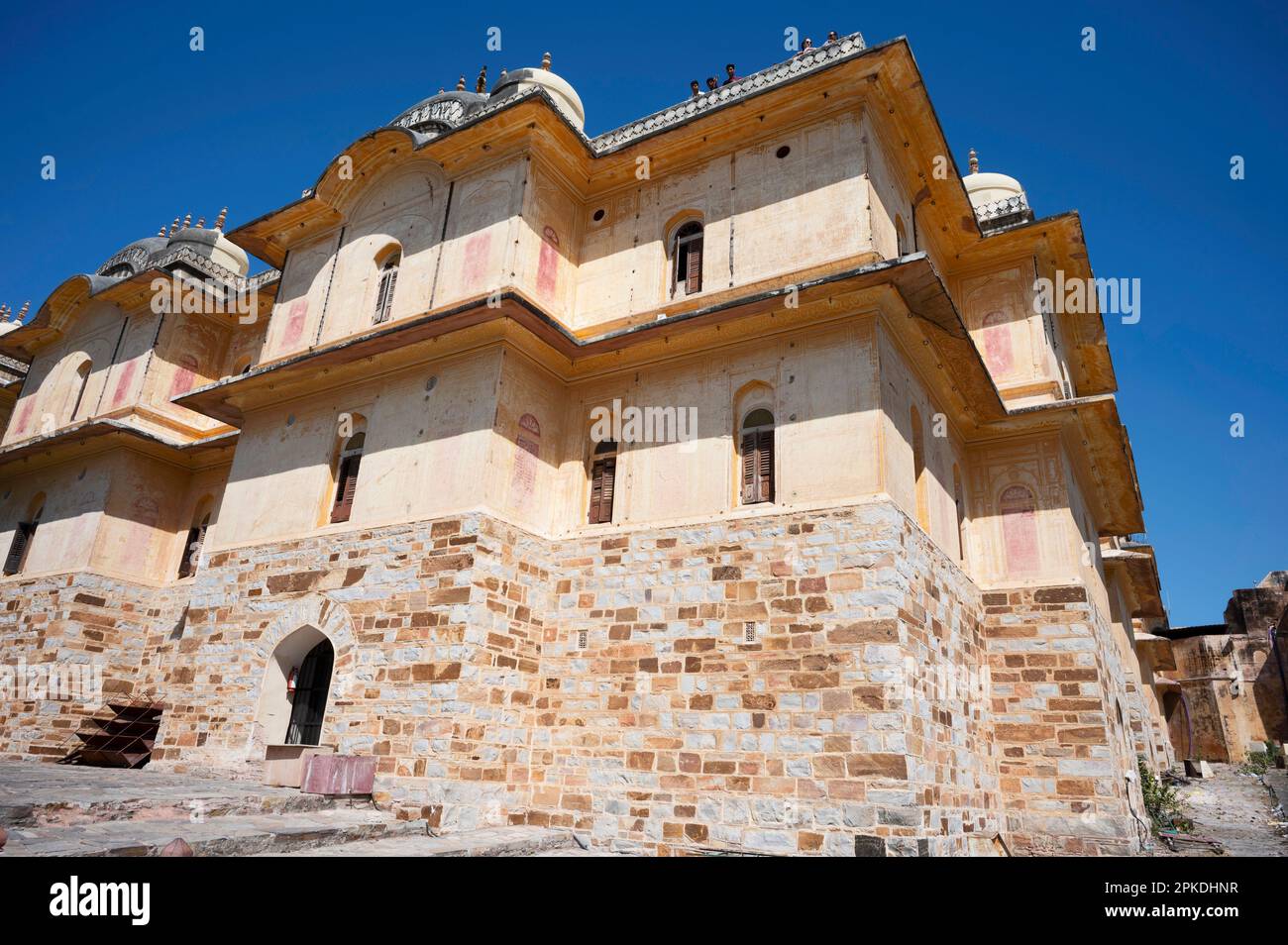
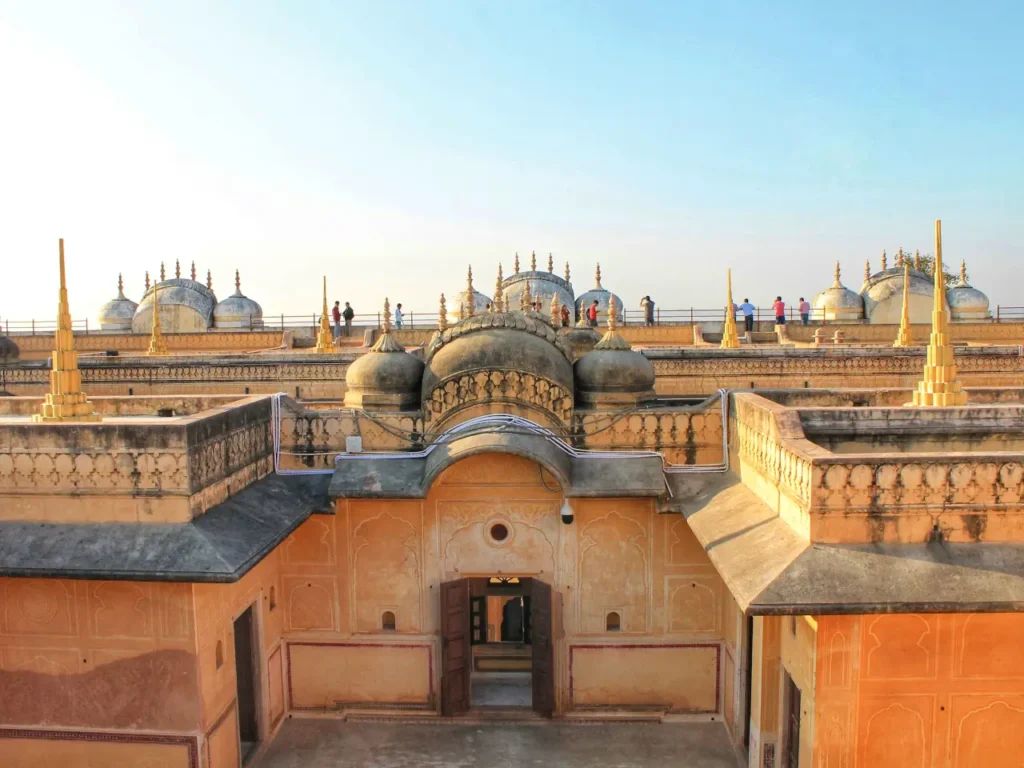
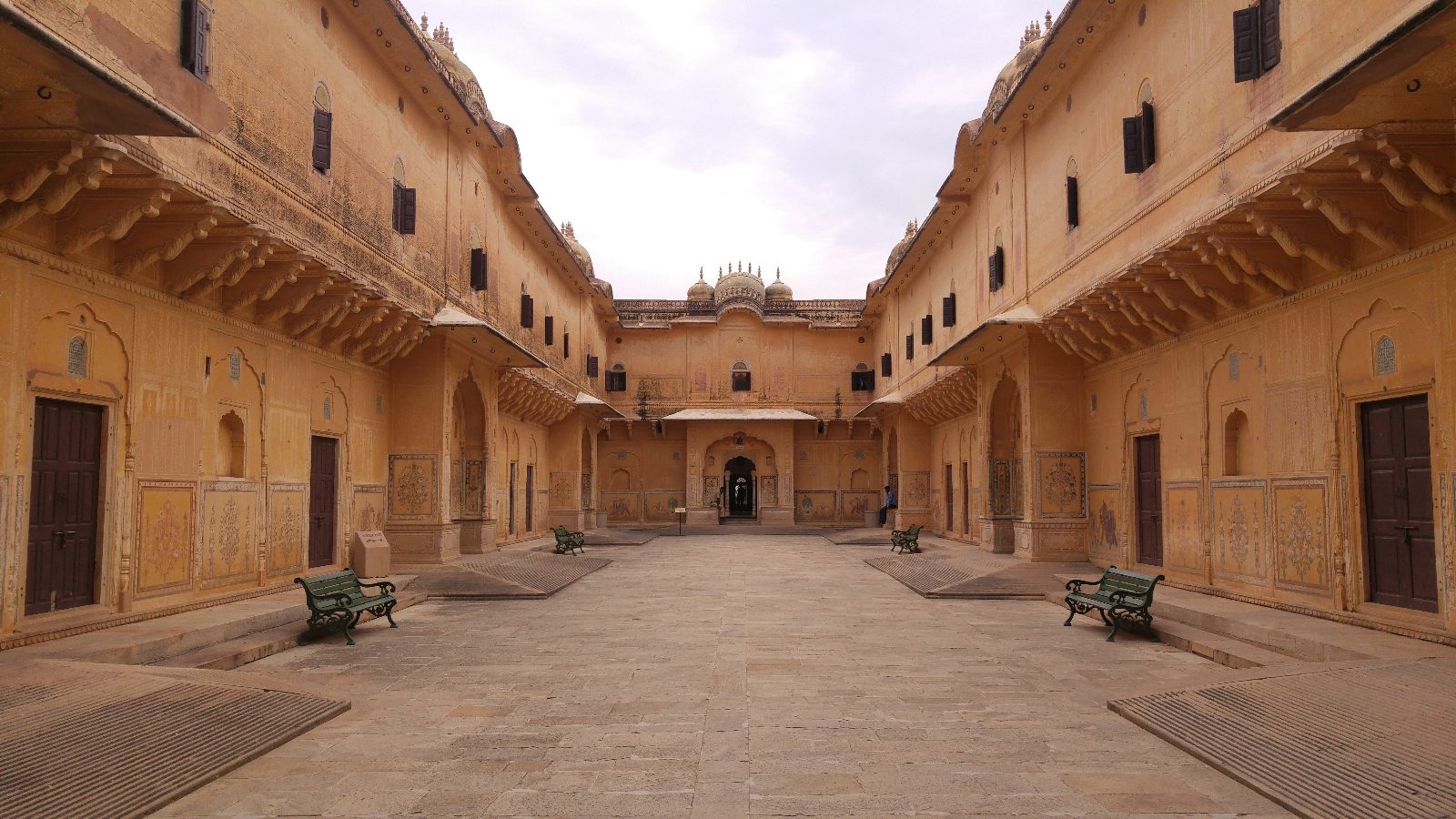
Explore the nine queens' suites, courtyards, and painted corridors of the two-story royal palace
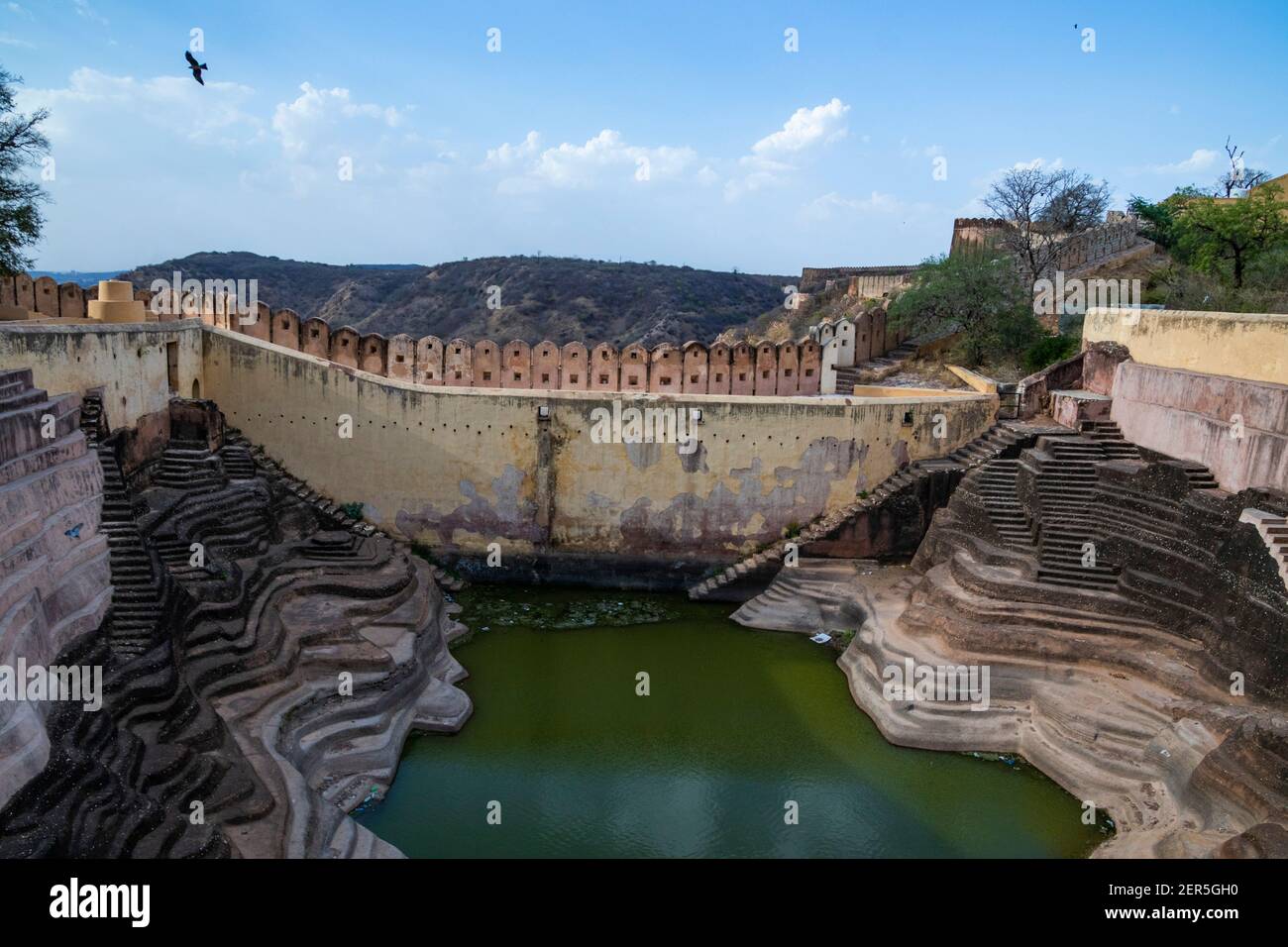
Follow the fort walls past the old baoli step well toward the northern viewpoint
Settle at the cliff-edge viewpoint overlooking Jaipur as the light turns golden
Optional stop for chai or snacks at the RTDC-run terrace before heading back down
A two-story palace complex built by Sawai Madho Singh II containing nine near-identical suites, one for each of his queens, connected by a shared central corridor decorated with murals and frescoes. Each suite includes its own bedroom, lobby, and kitchen, a layout meant to give every queen equal royal quarters.
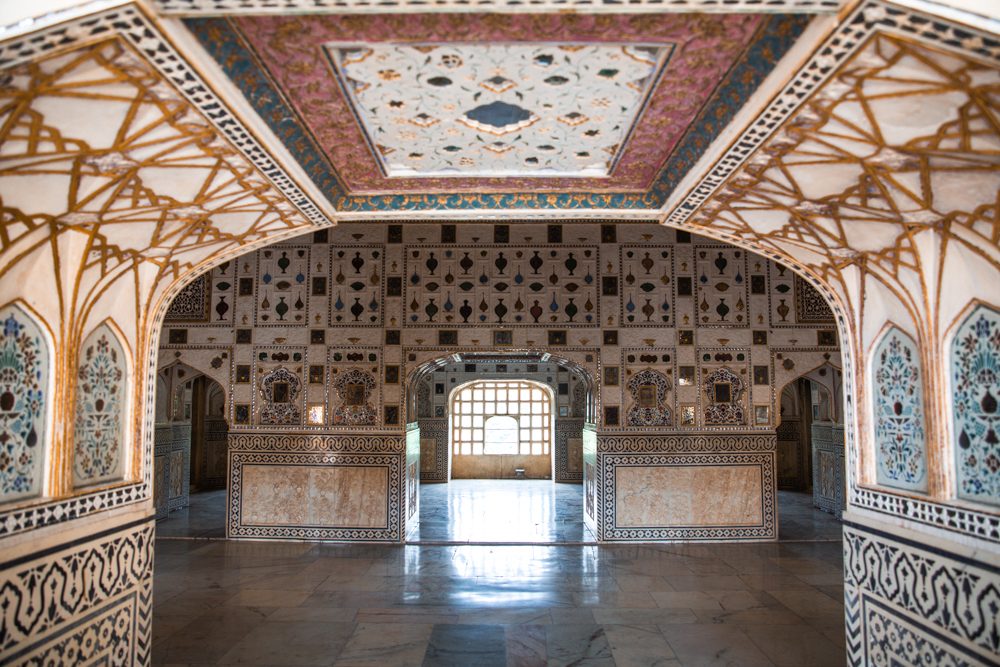
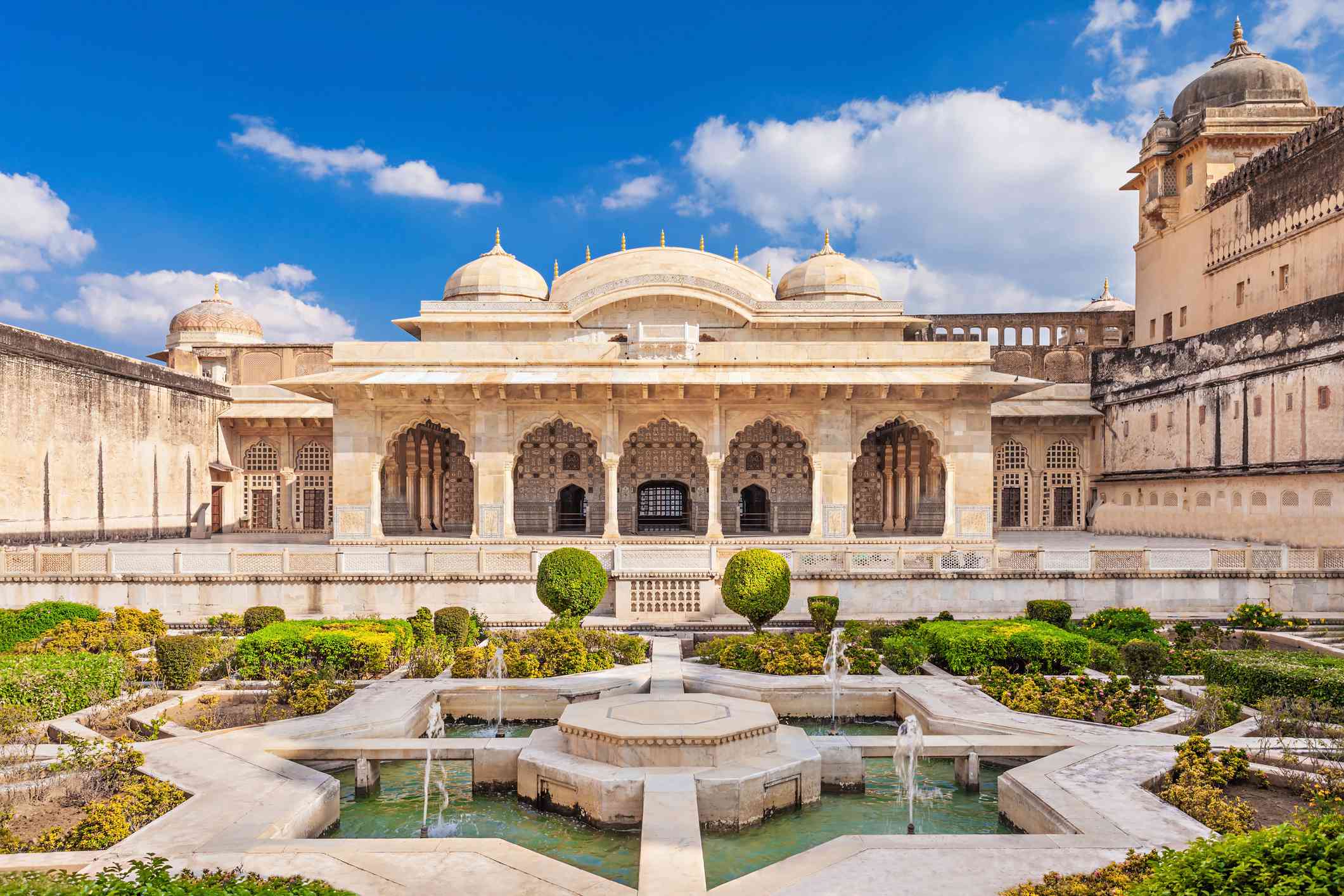
Known as the Palace of Mirrors, this hall was assembled using an estimated 2.5 to 25 million pieces of colored glass in blue, green, yellow, and red, combined with Thikri and gold-polish work. It was previously used as a warriors' rest house before its restoration into the current mirrored gallery.
Inaugurated in December 2016 by Bollywood actor Govinda, the museum displays more than 35 silicon and wax statues spanning Bollywood stars, sports figures, freedom fighters, and Jaipur's royal family. It sits just inside the fort's entrance, making it typically the first stop for visitors.
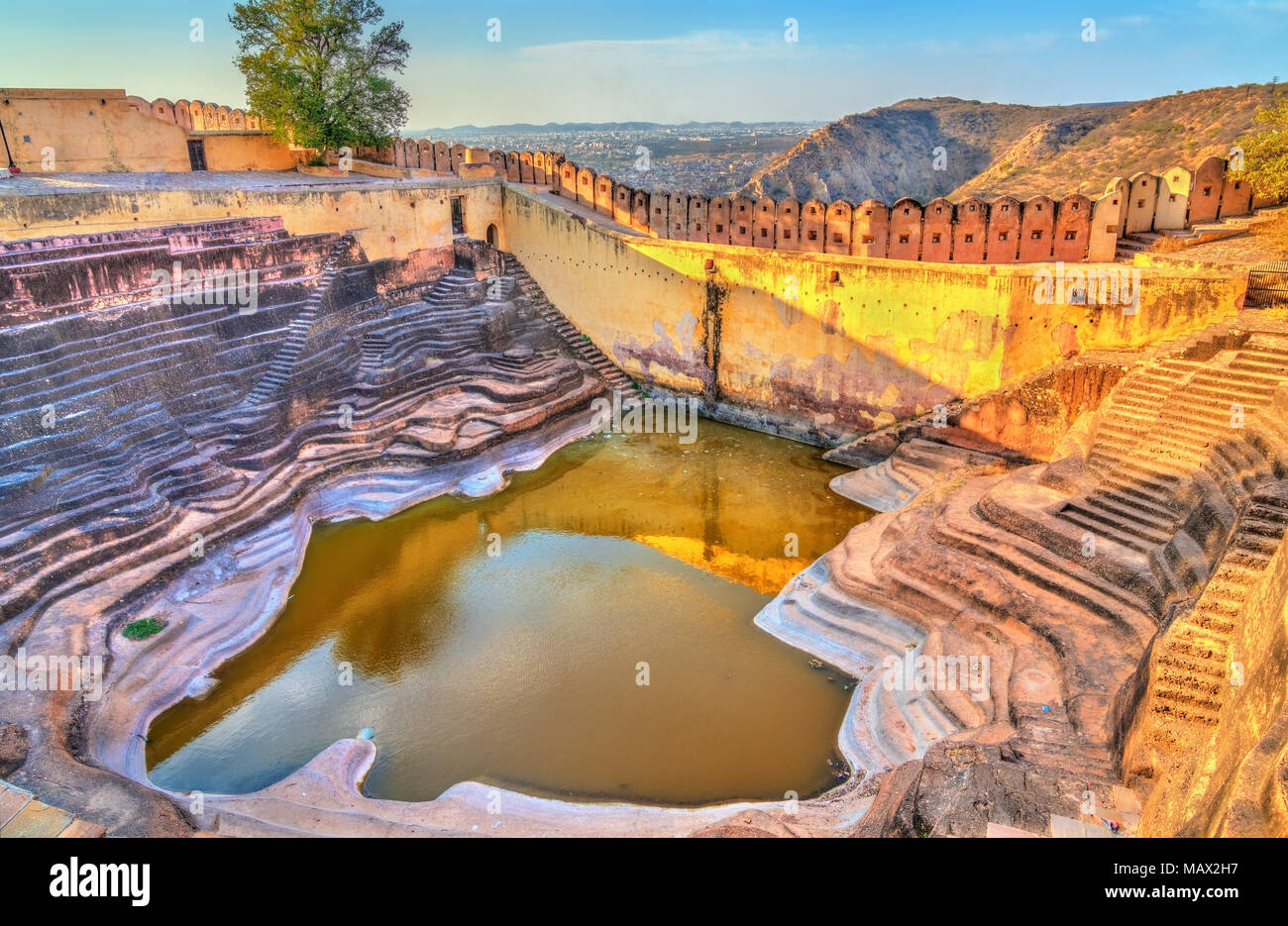
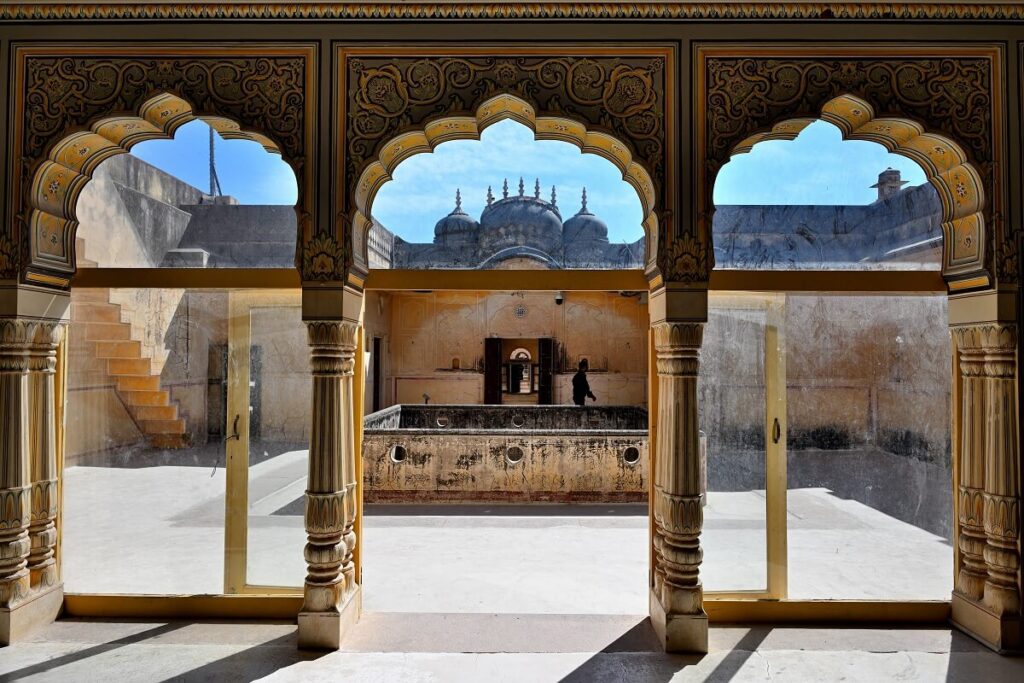
A small step well located almost directly opposite Madhavendra Bhawan, its still water reflects the sky and surrounding stonework. It formed part of the fort's original rainwater harvesting system built into the hillside.
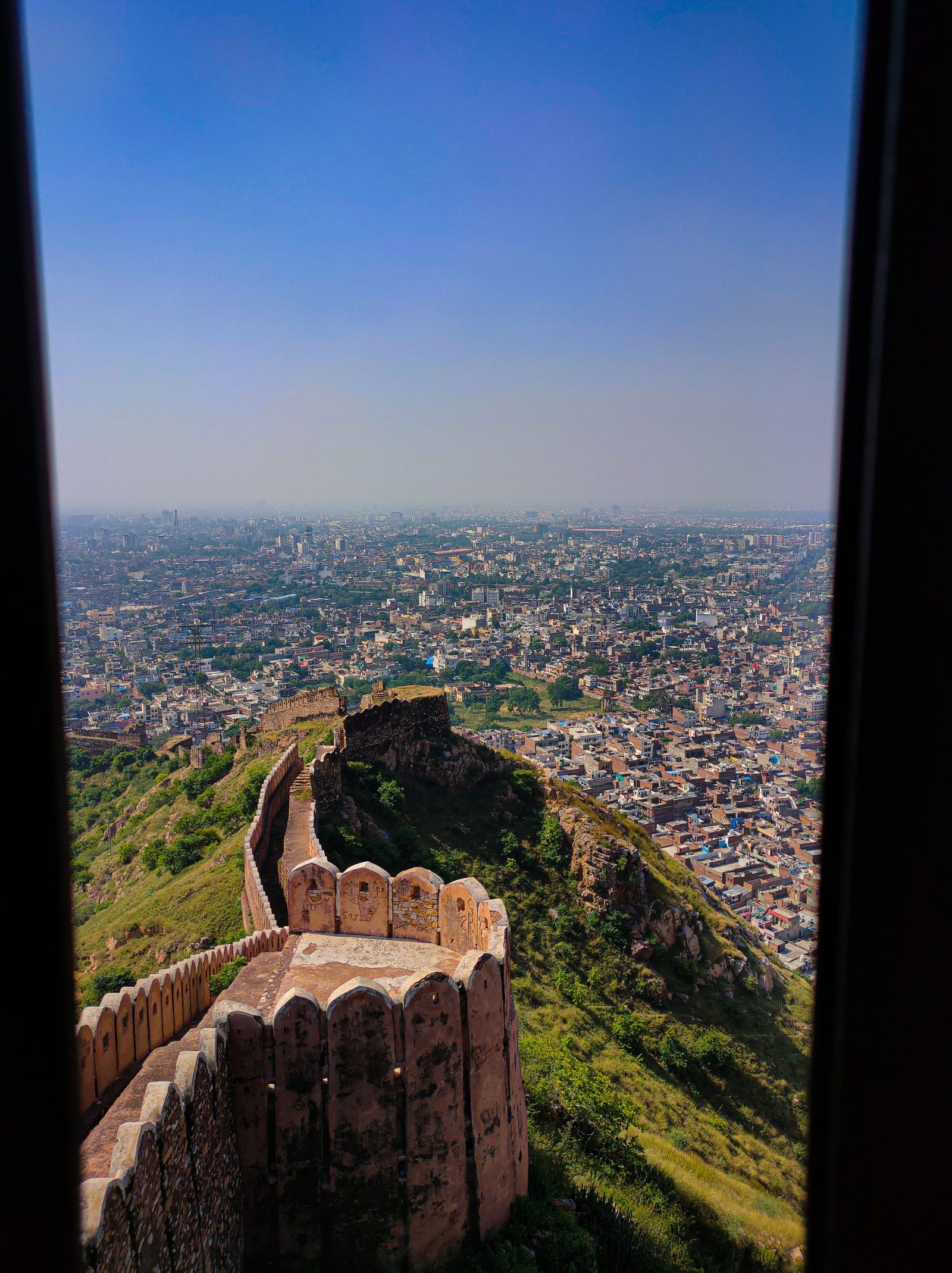
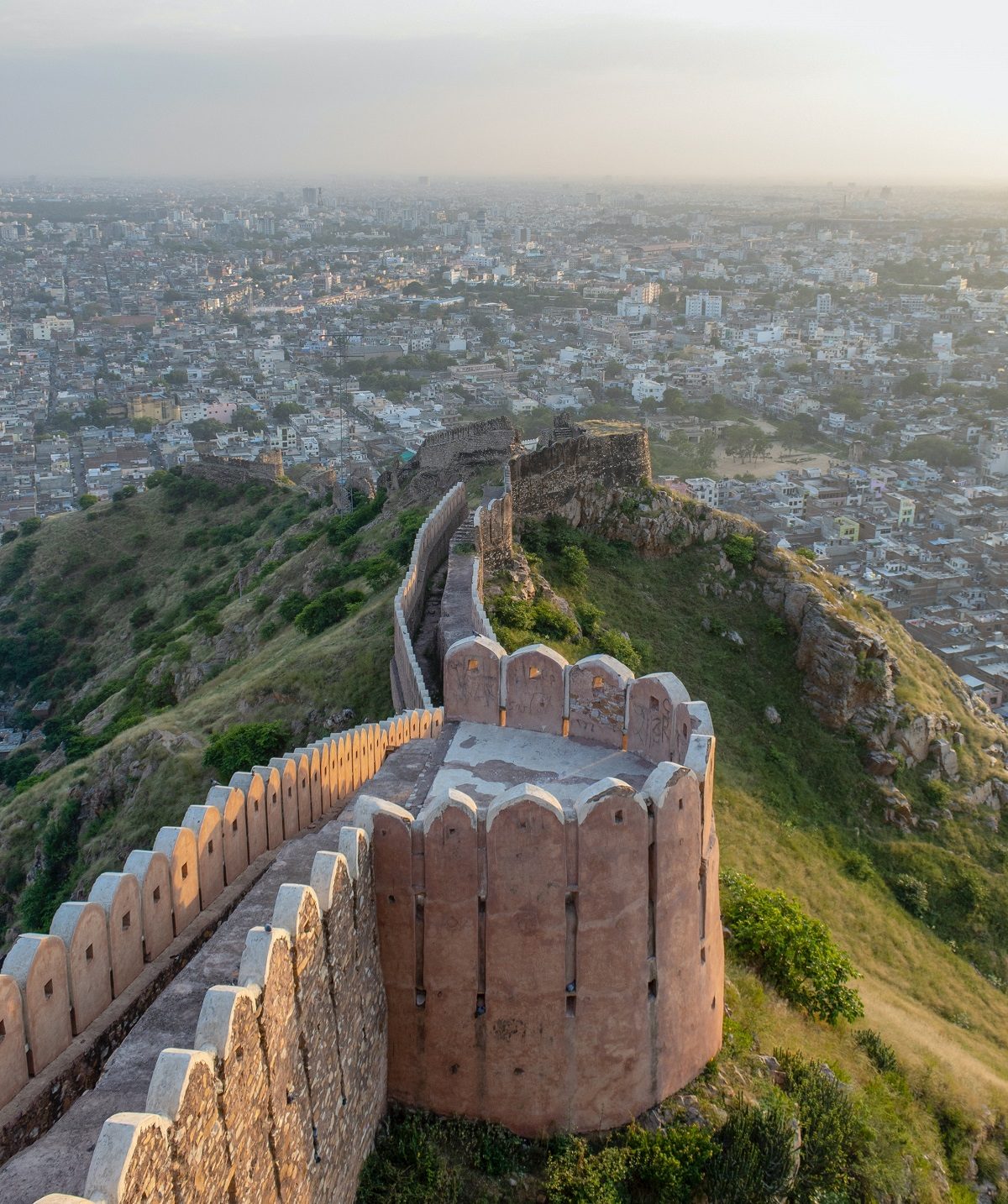
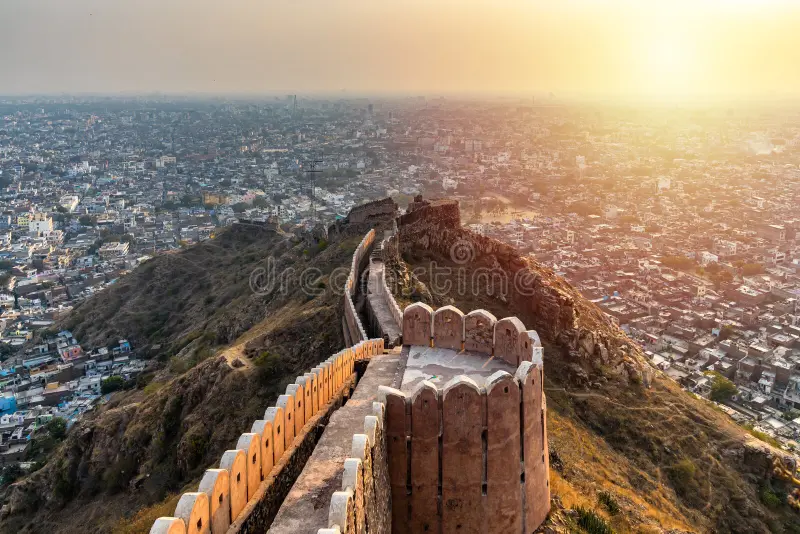
A cliff-edge stretch of the fort's outer wall offering an unobstructed view over Jaipur's grid layout and Man Sagar Lake in the distance. The ramparts extend for several kilometers along the Aravalli ridgeline, following its natural contours.
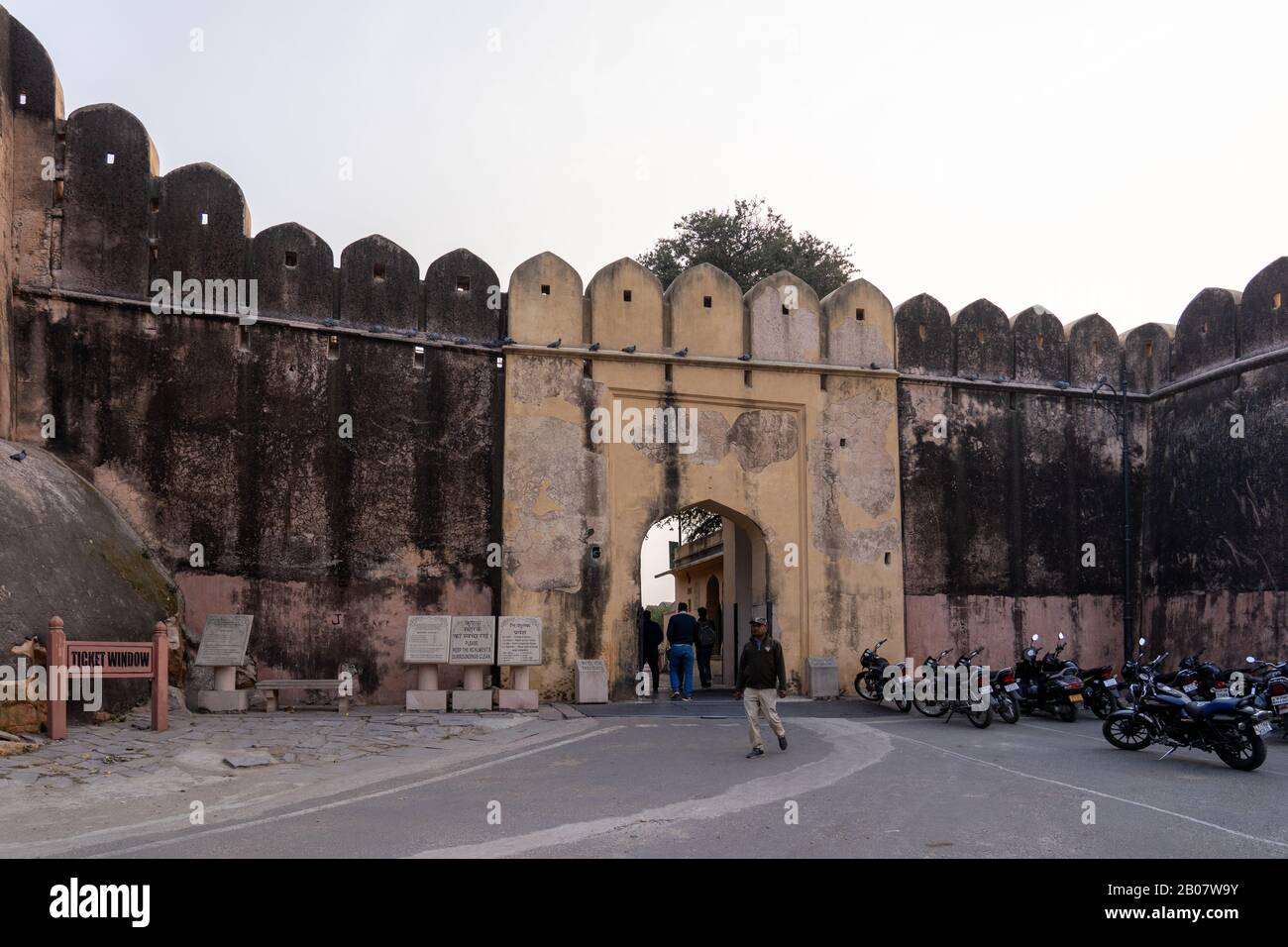
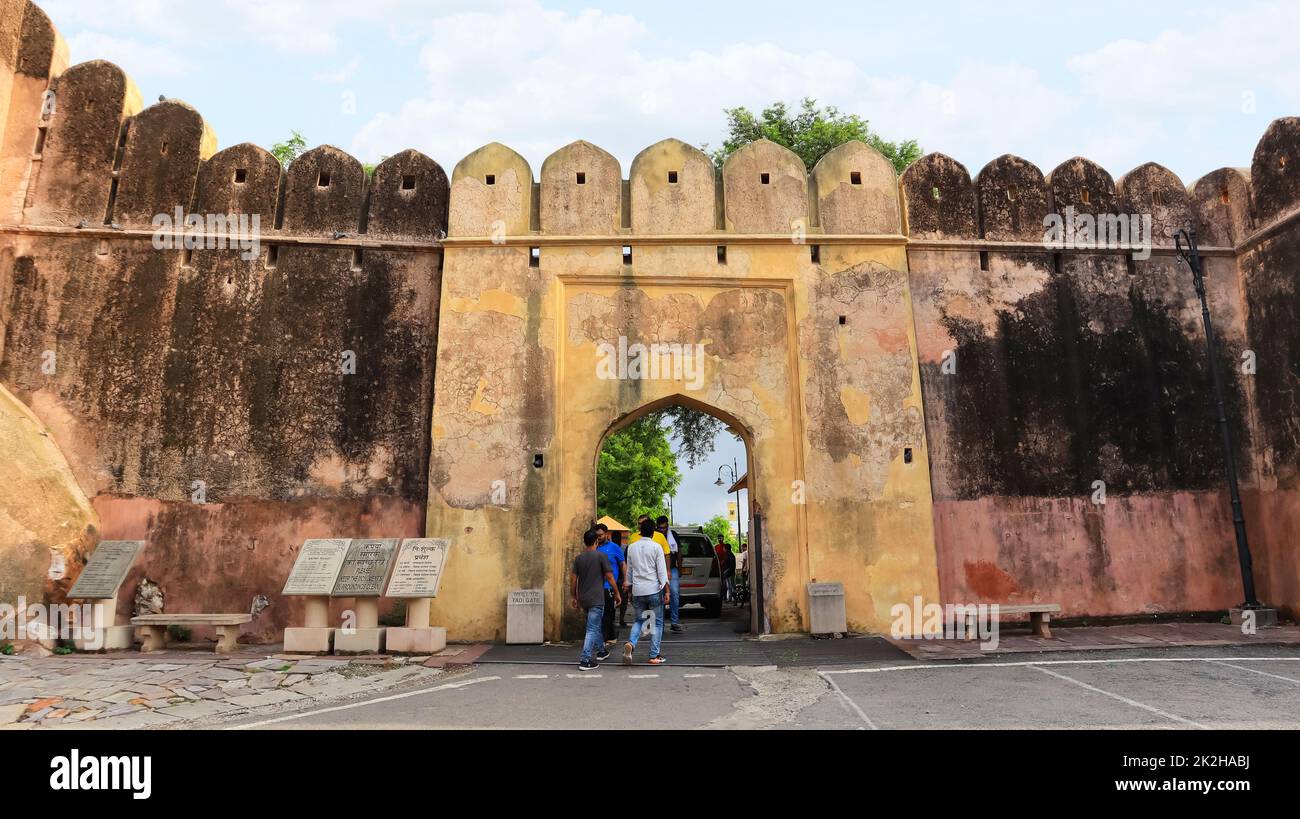
The fortified main gateway into Nahargarh Fort, historically the primary defended access point and the location of a temple dedicated to Nahar Singh Bhomia, the spirit for whom the fort was renamed.
You leave the Pink City behind and wind up the serpentine road into the Aravalli Hills, the grid of Jaipur shrinking below with each hairpin. At the gate you present your voucher and pass beneath the arched entrance into a courtyard of warm sandstone.
You climb first toward Madhavendra Bhawan, tracing the linked apartments where nine queens once lived, running a hand along cool frescoed walls and ducking through low connecting passages that open, one after another, onto shared terraces.
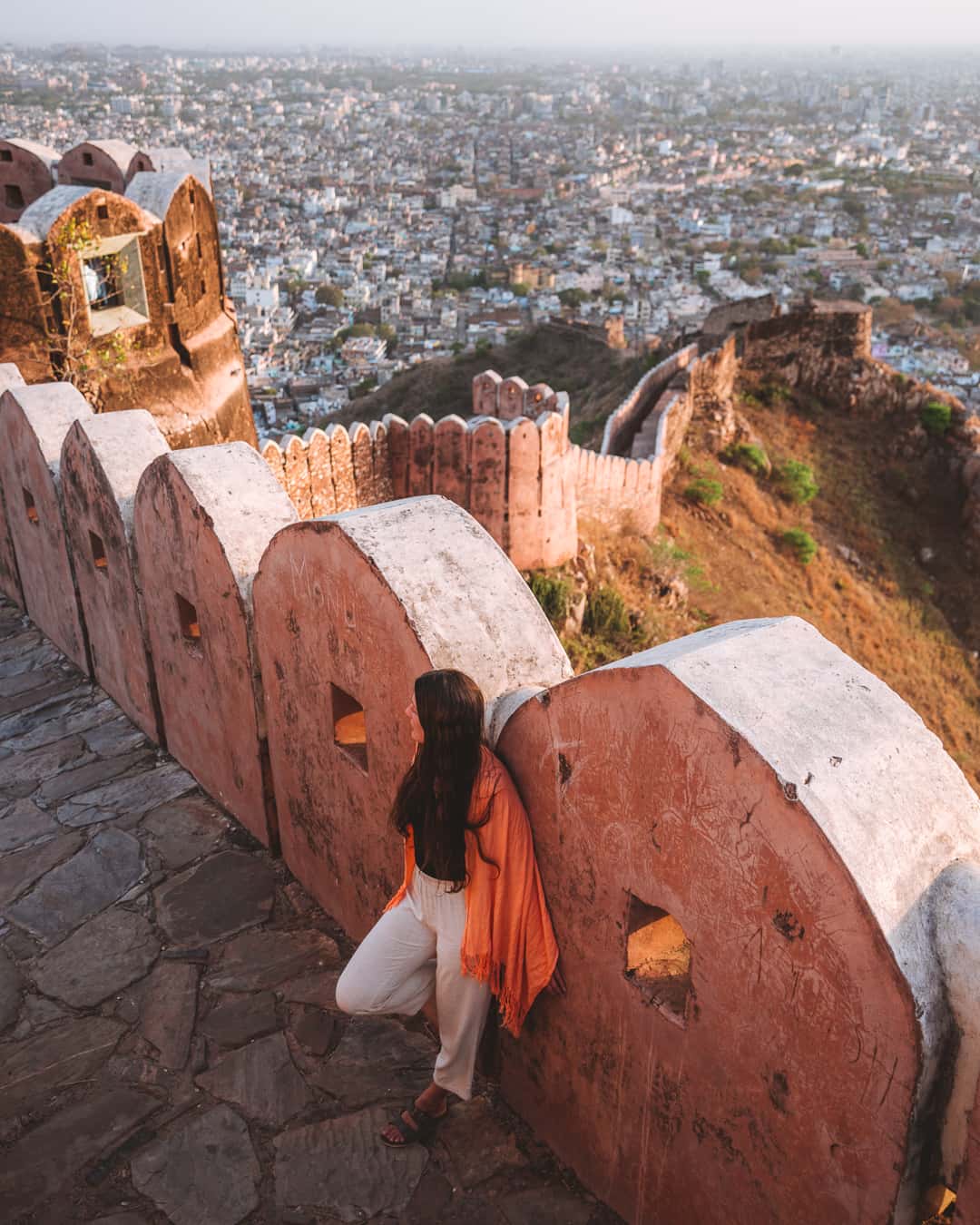
You follow the ramparts outward. The path along the curtain wall is uneven underfoot, so you watch your step as the whole plain widens to your left — Jal Mahal a pale rectangle on the lake, the ridge rolling toward Jaigarh. You pause at a bastion, lean into the parapet, and let the wind carry up from the city.
Timing your nahargarh fort tickets for the late window rewards you here: arriving between 15:30 and 17:00 puts you on the western walls as the light cools and the sun lowers over Jaipur before the 17:30 close. You climb a final stepped rise, find a quiet corner of stone, and watch the town below shift from ochre to amber. When the guards begin their round, you descend the winding road, the lit city rising to meet you.
All the details about your upcoming adventure in one place
Perched along the Aravalli ridge overlooking the Pink City, nahargarh fort tickets give you access to the ramparts, the Madhavendra Bhawan palace suites, and sweeping views across Jaipur's skyline and Man Sagar Lake. Guided nahargarh fort tickets tours pair the fort with easy walks to the wax museum and the stepwell, making it a relaxed introduction to Jaipur landmarks. Entry covers the main courtyards, and the elevated bastions remain one of the finest vantage points among the city's hilltop forts.
Nahargarh Fort was raised in 1734 under Sawai Jai Singh II, not as a palace but as a defensive retaining wall for the new capital below.
Its name — the Abode of Tigers — trails a folk story: the spirit of Nahar Singh Bhomia, a slain prince, was said to unsettle construction until a shrine was built within the walls to appease him. That shrine still stands inside the ramparts today.
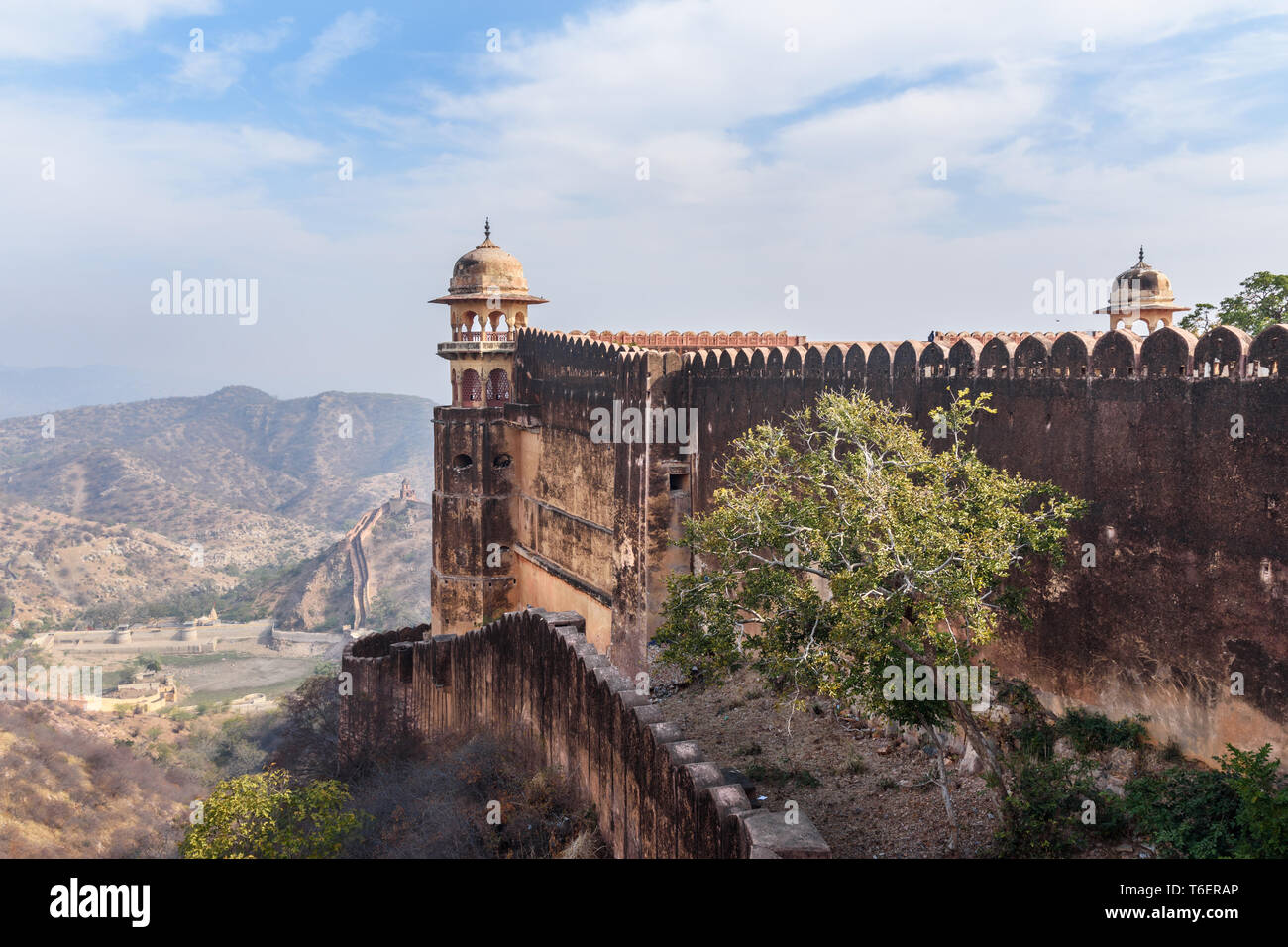
The fort crowns the Aravalli ridge at roughly 700 metres, its curtain walls threading the hills to link, in intent, with Jaigarh and Amber to form a single fortified line guarding Jaipur. For much of its early life it saw no siege. Its purpose was deterrence and vantage — a watchtower over the plain rather than a battlefield. In 1868 the fort was extended, and later Sawai Ram Singh II and Madho Singh II added the delicate Madhavendra Bhawan, a summer retreat of nine matching apartments arranged for the king and his queens, each suite linked by shared corridors and screened passages so the ruler could visit any wing unseen. Frescoes, stucco flourishes and fine lattice still mark those interiors, worn but legible. This is why nahargarh fort tickets draw travellers who want architecture read against a working landscape, not a museum piece behind glass.
What the fort offers now is continuity of view. From its bastions the whole grid of the Pink City unfolds — Jal Mahal floating on Man Sagar lake, the Aravalli folds rolling west, the haze of the old town settling at dusk. The site has doubled, in recent decades, as a cultural marker: film shoots, a wax museum and the stepped Padao restaurant sit within or beside the walls, and the surrounding biological park skirts its lower slopes. Yet the fort's core appeal remains the plain fact of elevation and stone, the sense of standing where sentries once stood.
Visitors weighing a jaipur nahargarh fort tour tend to fold it into the ridge circuit with Jaigarh and Amber, though Nahargarh rewards those who linger for its outlook alone. As one of the enduring Jaipur landmarks, it frames the city the way its builders intended — from above, at a remove, in full. Reserved-entry nahargarh fort tickets tickets help pace an arrival around the light rather than the crowd. The masonry has held for nearly three centuries; the view it was built to command has scarcely changed, and that unbroken sightline is what still carries people up the winding road to the gate.

Built as a wall rather than a palace, Nahargarh has always been less a fortress than a vantage point over the city it was made to watch.
There is no strict dress code enforced at the gate, but modest, breathable clothing is recommended since the walk from Tadigate up to Madhavendra Bhawan and the rampart walk is uphill and exposed to sun for long stretches. Sturdy, closed walking shoes are far more practical than sandals on the fort's uneven stone paths. Light layers help for the cooler post-sunset air if lingering past the 15:30–17:00 arrival window.
A security check with bag scanning and a metal detector takes place at the Tadigate entrance before visitors reach the ticket counter area. Backpacks and larger bags are permitted but may be opened for inspection, and outside tour guides are not allowed inside Madhavendra Bhawan, where guides can instead be hired at the entrance. Loose valuables should stay zipped away given the crowded corridors of the Sheesh Mahal and wax museum sections.
Personal photography and phone cameras are allowed throughout the ramparts, Madhavendra Bhawan courtyards, and the sunset viewpoint at no extra charge. Tripods and professional video rigs may require a separate permission from the Department of Archaeology and Museums, and any commercial or pre-wedding shoot needs prior written approval and a separate fee. Flash photography is discouraged inside the Sheesh Mahal to protect the mirror-work surfaces.
Children generally enjoy the Jaipur Wax Museum and Sheesh Mahal near the entrance, both of which involve less climbing than the upper ramparts. Strollers are difficult to manage on the stepped pathways, so a child carrier works better for toddlers. The open ledges along the rampart walk have low or no railings in places, so parents should keep young children close, especially during the busier 15:30–17:00 sunset window.
The climb from the Tadigate entrance up to Madhavendra Bhawan and the rampart viewpoint involves stone steps and sloped paths with no lift access, which makes the fort difficult for wheelchair users and travelers with limited mobility. Handrails exist on some of the steeper stretches near the palace corridors, but the terrain overall remains uneven. Visitors with mobility concerns are best served by the lower courtyard areas near the entrance and the Padao terrace, which require less climbing.
Packaged snacks and sealed water bottles may be carried inside, but visitors are asked not to litter within the fort grounds. The RTDC-run Padao restaurant inside the fort has its own separate entry charge and menu, and outside food is not permitted to be consumed inside that dining terrace. No cooking or open flame of any kind is allowed anywhere on the premises.
Midweek visits see lighter crowds
Weekend footfall rises sharply
Family groups peak in late afternoon
Hours today
10:00–17:30, last entry 17:00
Address
Nahargarh Fort, Aravalli Hills, Krishna Nagar, Brahampuri, Jaipur, Rajasthan 302001, India
Terrain
Uphill ramparts and stone steps, wheelchair access limited
Best light
15:30–17:00 for cooler air and sunset views over Jaipur
Bag policy
Small bags allowed, large backpacks screened at Tadigate entrance
Layout
Enter via Tadigate, then Madhavendra Bhawan, Sheesh Mahal, and the rampart viewpoint
Car · 35-45 minutes from the city center · Parking approx. 50-100 INR
Drive via Amer Road or Nahargarh Fort Road; the route climbs a winding, well-paved uphill stretch with parking available near the entrance for a nominal fee.
Taxi · 30-40 minutes · Approx. 300-500 INR one way
A one-way cab or app-based taxi from Hawa Mahal or the old city covers roughly 6-7 km of uphill road directly to the Tadigate entrance.
Public transport · 45-60 minutes total · Bus approx. 20 INR plus auto-rickshaw fare
City buses run from Hawa Mahal to the foothill of the fort, but no direct bus reaches the hilltop gate; a shared auto-rickshaw covers the final climb.
Bike · 30-40 minutes · Rental approx. 400 INR per day
Renting a scooter or motorbike offers flexibility for the steep, curvy final approach road, though caution is advised on blind turns near Amer.
Nahargarh Fort tickets booked online can typically be cancelled up to 24 hours before the visit date for a full refund of the 600 INR foreign adult entry fee; cancellations inside that window are usually non-refundable. Date changes are generally permitted once, subject to availability, when requested before the original visit date.
Recommended time
2-3 hours
Most travelers booking nahargarh fort tickets budget two to three hours to cover the courtyards, Madhavendra Bhawan, and the ramparts at a relaxed pace. Add another 30-45 minutes if you're chasing sunset light from the 15:30-17:00 arrival window, since lingering at the viewpoint eats into that base estimate quietly. Subtract time only if you're doing a brisk walk-through without the museum wing. Queues are rarely an issue outside the pre-closing rush, when the ticket counter and parking lot both bottleneck as day-trippers arrive for golden hour.
Crowd levels through the day
Weather · crowds · average price — dots go green to amber to red as each metric rises.
Daytime highs of 20-25°C make this the most comfortable season for the uphill walk to Madhavendra Bhawan. Evenings can turn chilly by sunset, so a light jacket helps at the viewpoint. Crowds peak around New Year and the Republic Day long weekend in late January.
Daytime temperatures often exceed 38-40°C, making the exposed rampart walk uncomfortable outside the 15:30–17:00 window. Mornings are quieter but the heat builds quickly after 11:00. Late afternoon visits timed near closing avoid the worst of the sun.
Rainfall keeps the Aravalli Hills green and cooler, with July and August seeing the heaviest showers and occasional path slickness on the stone steps. Visibility for the Jaipur skyline view can be reduced on cloudy afternoons. Weekday visits during this season tend to be markedly less crowded.
This stretch draws the heaviest tourist volume of the year alongside school holidays and New Year travel, so the fort's courtyards and viewpoint get busiest in the final hour before closing. Arriving right at opening avoids the worst of the midday crush.
Since intra-day timing is covered elsewhere, simply note that the fort gets noticeably busier in the final hour before closing during winter weekends.
Vehicle parking, the golf-cart style shuttle at the base, and snacks at Padao are typically cash transactions rather than card payments.
Guides are not permitted to enter Madhavendra Bhawan from outside; hire one at the entrance to the palace itself if you want a guided walk-through.
Travelers visiting Amer Fort, Jaigarh Fort, or Hawa Mahal on the same trip may find the multi-monument composite pass more economical than paying separately at each gate.
The stone paths along the outer walls are uneven and occasionally narrow, so flat, closed shoes matter more here than at flatter city monuments.
Because the fort borders the Nahargarh Biological Park's forested slopes, staff discourage lingering near the outer walls after the gates close.
Carrying a copy of any pre-booked confirmation speeds up the entry line at Tadigate during weekend rushes.
Nahargarh Fort, Aravalli Hills, Krishna Nagar, Brahampuri, Jaipur, Rajasthan 302001
Ticket counter and security check point, main gathering spot for groups
Get directionsNahargarh Fort Road foothill, Jaipur
Where buses and larger vehicles stop before the final uphill auto-rickshaw ride
Get directionsIn 1734, Sawai Jai Singh II ordered the fort raised on the ochre ridge above his three-year-old city. The founder first named it Sudarshangarh. Jaipur landmarks rarely stood alone, and this bastion completed a defensive ring with Amer to the north and Jaigarh on the neighbouring crest. Signal fires and walled corridors linked the trio. Together they guarded the Aravalli passes that fed into the Kachhwaha capital. The name did not survive. Local tradition holds that construction faltered nightly, walls collapsing by dawn. The disturbance was blamed on Nahar Singh Bhomia, a Rathore prince whose spirit haunted the site. A shrine was built to appease him, and the fort took his name: Nahargarh, the abode of tigers. Understanding this legend gives depth to any nahargarh fort tickets tour, since the story is mortared into the ramparts themselves. The fort's second great chapter arrived in 1868. Sawai Ram Singh II commissioned the palace block, and his successor Sawai Madho Singh II extended it. The result was Madhavendra Bhawan, a two-storey summer retreat completed under royal patronage. Its design placed nine identical apartments for the king's queens along a single corridor, each linked to the ruler's suite yet screened from the others. Frescoed walls and lattice ventilation cooled the ridge-top rooms through Rajasthan's fierce heat. What began as a military outpost became a place of leisure, and this transformation is the thread most nahargarh fort tickets tours now follow. The founding stones of 1734 still bear the marks of Sudarshangarh, while the 1868 chambers preserve the retreat's later grace. The Aravalli hills that once demanded watchtowers now frame the sunset views the ramparts are known for. A well-planned nahargarh fort tickets tickets visit reads these two eras against each other. Jaipur city tour itineraries treat the ridge as the point where defence and pleasure meet, and the surviving fabric confirms both readings.
Sawai Jai Singh II founds the fort as Sudarshangarh within the Aravalli defensive ring.
Legend of Nahar Singh Bhomia's spirit halts building until a shrine renames it Nahargarh.
The fort links Amer and Jaigarh, guarding the passes above the new Jaipur capital.
Sawai Ram Singh II commissions the palace block that becomes Madhavendra Bhawan.
Sawai Madho Singh II extends the retreat with nine screened queens' apartments.
The founding walls and summer palace both survive as the ridge's enduring landmark.
A small rooftop pavilion at the fort's edge near Padao Restaurant, where you can climb atop the structure for an open view of Jaipur's rooftops fading into haze below. It is the most photographed spot in the complex, so arrive early to claim the top ledge before the crowd builds.
Walk the crenellated wall stretching west from the main courtyard and frame the Pink City through a gap in the battlements, using the stone parapet as foreground. Photographers booking nahargarh fort tickets for this exact angle should head past the restaurant crowd toward the quieter stretch of wall closer to the entrance for open sightlines.
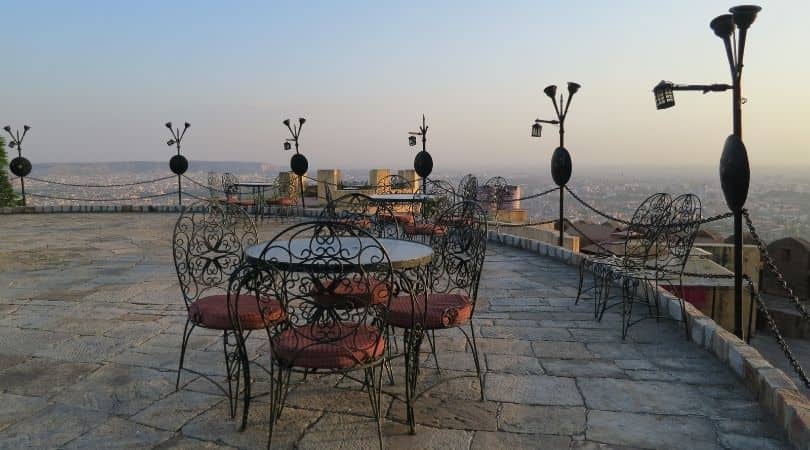
The open-air terrace bar looks straight over the western plains and the sprawl of Jaipur below, giving a clean elevated frame for wide shots of the skyline turning gold. Shots from here are classic but crowded once drinks service starts, so a quick pass earlier for photos then a return for the actual sunset works well.
The palace's inner courtyard, built as nine identical queens' suites around a symmetrical arched corridor, gives a strong architectural frame with painted walls and repeating archways. Stand centered in the courtyard for a symmetrical shot down the corridor line, best before the light turns harsh.
Several pull-out points along the winding road up through the Aravalli forest let you shoot the fort's battlemented walls rising above the tree canopy, useful for an establishing shot before entering. This works well for anyone planning a fuller nahargarh fort tickets tour that includes the drive up as part of the visit.
Dining options right at the fort are limited but real: pick up your nahargarh fort tickets and the only proper meal stop inside the walls is Padao, an RTDC-run terrace restaurant, while everything else is a walk back down toward Jaipur.
The sole on-site dining option, tucked on the fort's western edge with a separate small entry charge on top of nahargarh fort tickets tours pricing. Order chai, pakoras or chilli chicken and grab a tiered terrace seat before 17:00, since tables fill fast as the sunset crowd arrives ahead of closing time. Service is relaxed rather than quick, so it suits a lingering stop, not a rushed bite between sightseeing.
Small roadside stalls near the base of the winding approach road sell samosas, kachori and cold drinks, handy for a quick snack before or after your nahargarh fort tickets tour if Padao's terrace is full.
Real experiences from real travelers
We climbed up as the heat eased around five and the whole Aravalli ridge glowed amber. Buying our nahargarh fort tickets at the gate took barely two minutes on a weekday, and the walk along the ramparts gave us the widest view of Jaipur we found anywhere. The stone still held the day's warmth under our hands.
The fort sits high on the hill and the panorama across the Jaipur landmarks below is what stayed with me. We wandered the pastel rooms of Madhavendra Bhawan for a while, mostly empty in the late morning. A calm, breezy spot compared to the crowded palaces in town.
Nahargarh Fort surprised me with how much there was to explore beyond the walls. The nine identical suites built for the queens are worn but charming, and light moved through the arches beautifully in the afternoon. Bring water in summer because there is little shade on the climb.
We timed our visit for the evening and the sky turned deep orange over the hills. Sorting out the nahargarh fort tickets tickets online beforehand meant we skipped the small queue and headed straight to the Padao viewpoint. The wind picked up as the sun dropped and the city lights began to flicker on.
A jaipur nahargarh fort tour felt like the natural pairing with the ridge itself, and the drive up winds past monkeys perched on the parapets. The 18th-century walls stretch further than expected and connect toward Jaigarh. We spent the cooler part of the morning here and never felt rushed.
The stepwell tucked inside caught me off guard, all sharp geometry and shadow. Getting nahargarh fort tickets was straightforward and the staff pointed us toward the frescoed royal chambers first. It gets bright and exposed by midday so an earlier start helped.
Standing on the ramparts with the Aravalli hills rolling out behind and Jaipur spread below was the highlight of our trip. We booked skip-the-line nahargarh fort access and the extra time let us linger in the wax museum wing. The evening breeze up on the ridge was a relief after the streets.
After the rains the hills around the fort turned lush and the air smelled of wet earth. The old cannon-era walls and watchtowers make for a slow, unhurried walk. One of the more peaceful jaipur landmarks we visited, and the light through the arches was soft all afternoon.
The Nahargarh Fort ramparts give a clean sweep across the whole city and it is easy to see why it guarded old Jaipur. We picked up nahargarh fort tickets tours as part of a combined pass and it saved fumbling at each counter. Midday sun was strong so a hat is essential.
The interconnected queens' apartments with their pale painted walls felt frozen in time and were almost deserted when we arrived. A nahargarh fort tickets tour led us through the corridors and up to the terraces for the ridge view. The stone underfoot was smooth from centuries of footsteps.
Everything you need to know for your journey
Nahargarh Fort is open daily from 10:00 to 17:30, with last entry generally recommended by 17:00 to allow time inside before closing.
The foreign adult entry fee for nahargarh fort tickets is 600 INR under the revised gazette rate effective January 2026.
The climb from the entrance to Madhavendra Bhawan and the ramparts involves stone steps and sloped paths with no lift, so mobility-impaired visitors may find the upper sections difficult.
A security check with bag scanning takes place at the Tadigate entrance, and large bags may be opened for inspection before nahargarh fort tickets are verified.
Personal photography is allowed throughout the fort at no extra cost, though tripods and commercial shoots need prior permission from the Department of Archaeology and Museums.
The best arrival window is 15:30 to 17:00, which offers cooler light and sunset views over Jaipur before the fort closes, making it a strong finishing point on a Jaipur landmarks tour.
There's no enforced dress code for nahargarh fort tickets, but modest, breathable clothing and closed walking shoes are recommended for the uphill stone paths.
Packaged snacks and sealed water may be carried in, while the on-site Padao restaurant offers its own separate menu and entry charge.
Most visitors reach the fort by taxi or auto-rickshaw via Nahargarh Fort Road, since no direct public bus reaches the hilltop gate; parking is available near the entrance for a small fee.
Yes, families commonly visit the Jaipur Wax Museum and Sheesh Mahal near the entrance, though strollers are difficult to manage on the stepped upper pathways.
Cancellations made at least 24 hours before the visit date on nahargarh fort tickets tickets are typically eligible for a full refund of the 600 INR entry fee.
Jaigarh Fort and Amer Fort sit within a short drive and share Nahargarh's Aravalli Hills defense history, making them natural additions to a single-day Jaipur landmarks tour.
Connected to Nahargarh by a fortification wall, this hilltop fort houses the Jaivana cannon, once the largest wheeled cannon in the world. Its watchtowers offer a companion view of the Aravalli ridge.
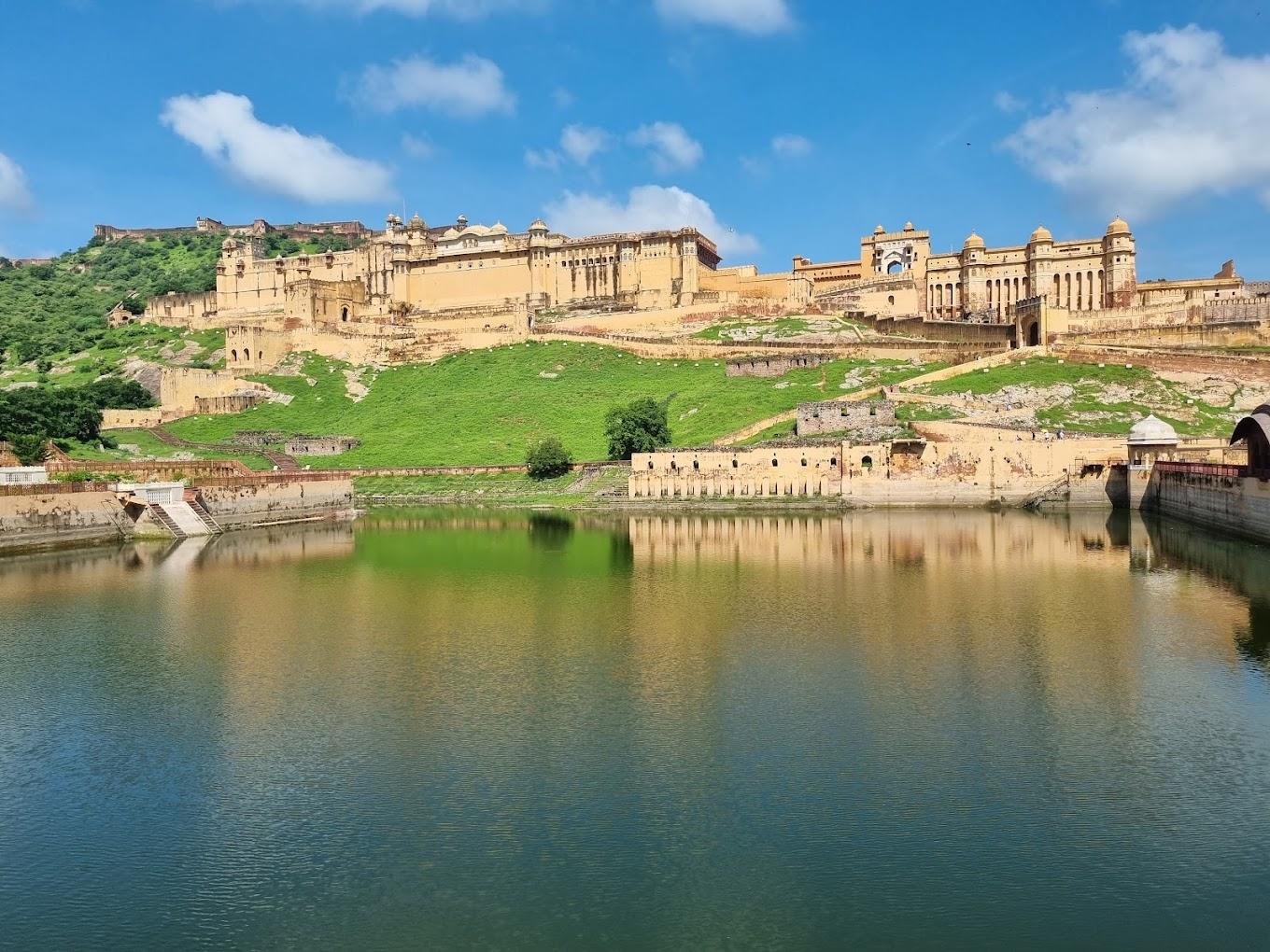
A UNESCO World Heritage hill fort with mirrored Sheesh Mahal and courtyards, historically linked to Nahargarh and Jaigarh as Jaipur's three-point defense system.
A five-story palace that sits partly submerged in Man Sagar Lake, viewable only from the lakeside promenade below.
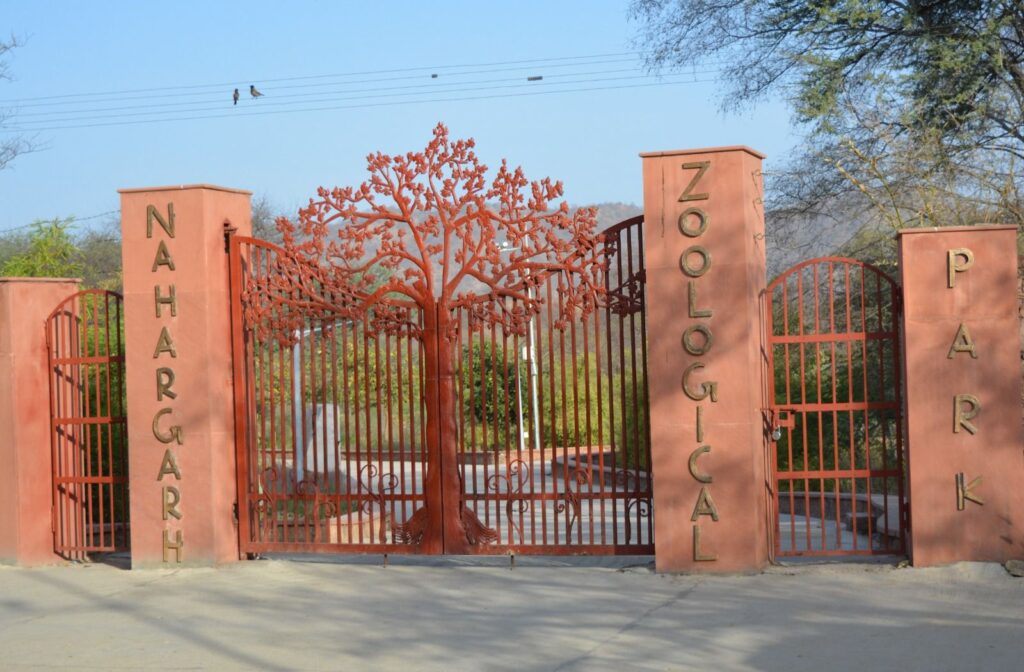
A zoological park adjoining the fort with Asiatic lions, Bengal tigers, and Indian leopards across several square kilometers of forested terrain.
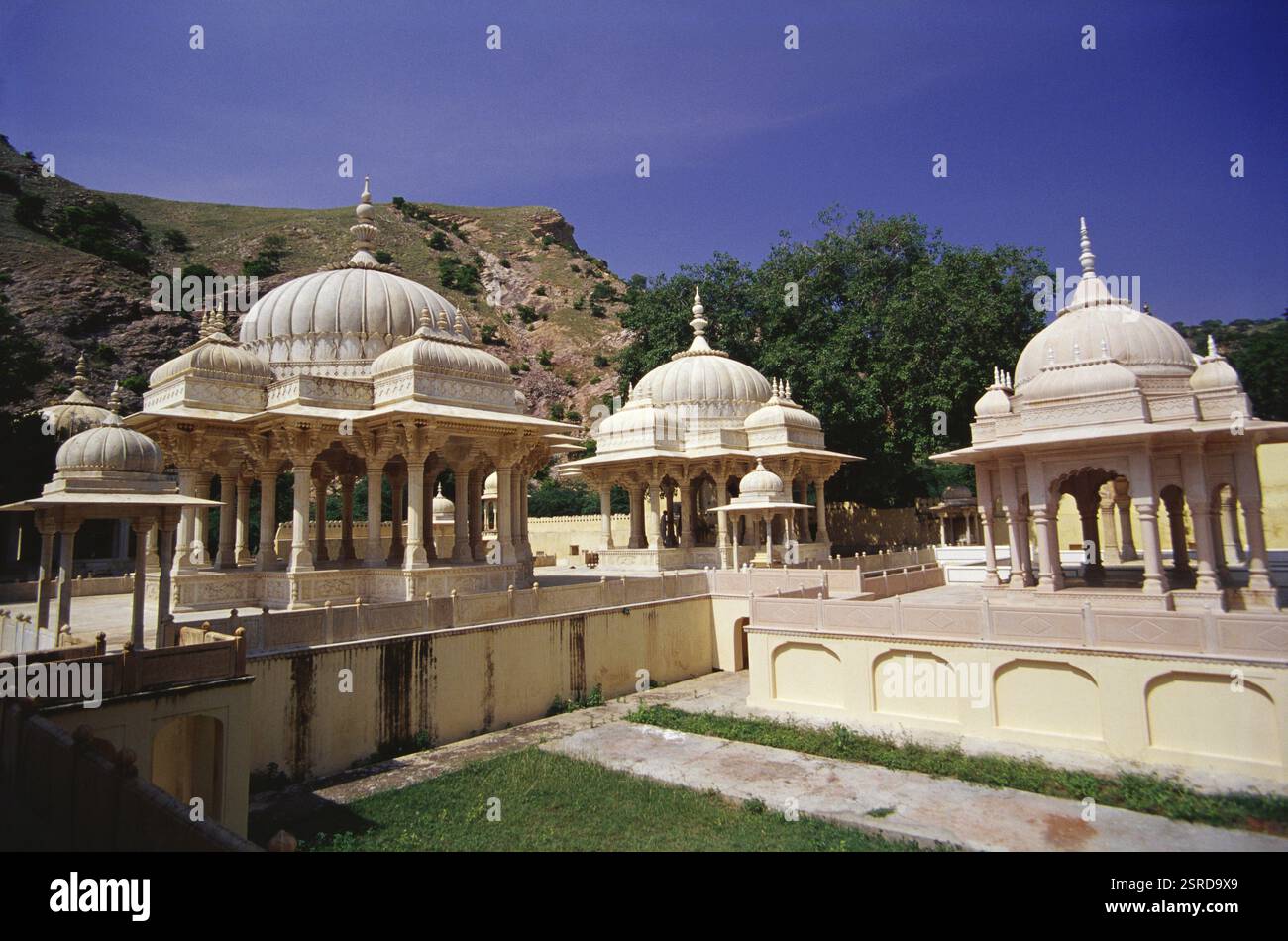
Marble cenotaphs commemorating Jaipur's former maharajas, set in a quiet walled garden below the fort.
Heritage haveli-style stays scattered along the base roads near Amer and Nahargarh, popular for rooftop views of the surrounding hills.
A leafy, central Jaipur district with a mix of mid-range hotels and easy access to both the old city and the fort circuit.
Dense with budget guesthouses near Hawa Mahal and Johari Bazaar, convenient for combining fort visits with old-city sightseeing.
Home to several of Jaipur's larger luxury hotel properties, a longer drive from the fort but well connected to the airport.
Join thousands of happy travelers who have discovered this incredible experience
Book Your Experience Now